 English
  Français
  Español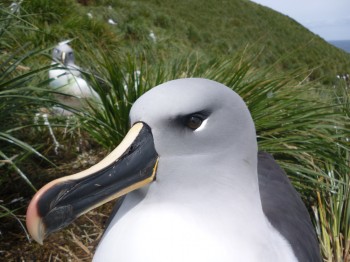
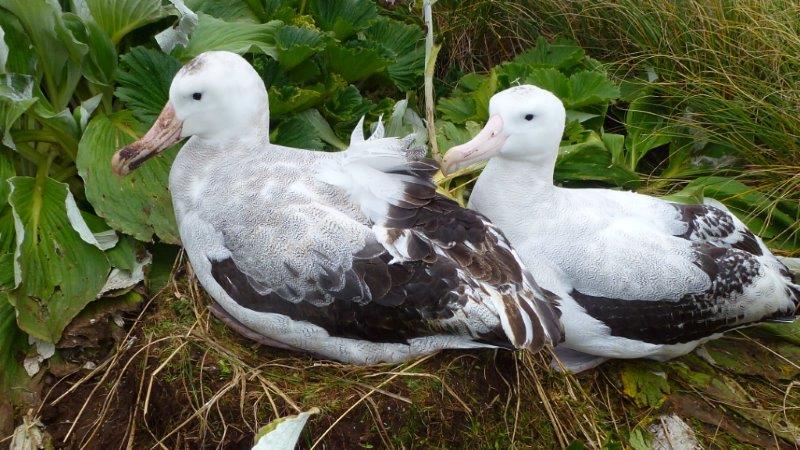
A breeding Grey-headed Albatross on Bird Island, photograph by Richard Phillips
Elizabeth Mackley (British Antarctic Survey, Madingley Road, Cambridge, UK) and colleagues have published in the open access journal Endangered Species Research on the most recent survey of three albatross species on South Georgia/Islas Georgias del Sur* in the South Atlantic.
The paper’s abstract follows:
“Marine ecosystems face multiple human threats, and many species are declining. The wandering albatross Diomedea exulans, black-browed albatross Thalassarche melanophris and grey-headed albatross T. chrysostoma are categorised globally as Vulnerable, Least Concern and Endangered, respectively, by the IUCN. The populations at South Georgia are listed by the Agreement on the Conservation of Albatrosses and Petrels as High Priority Populations for conservation, and to determine their current status and trends, we surveyed all breeding sites of wandering albatrosses, and ~30 % and ~73% of black-browed and grey-headed albatrosses, respectively. Comparisons with previous surveys indicated considerable variation in trends among sites and slower rates of decline from 2014/2015 to 2023/2024 than from 2003/2004 to 2014/2015: wandering albatross –0.1 vs. –1.7 % yr–1; black-browed albatross –1.1 vs. –1.8 % yr–1; grey-headed albatross: –4.1 vs. –5.0 % yr–1. Updated population estimates for South Georgia were 1278, 55 119 and 18 475 breeding pairs of wandering, black-browed and grey-headed albatrosses, comprising 13.3, 7.6 and 28.7 % of revised global totals and reflecting major declines of 39, 46 and 66 %, respectively, in just 32 to 40 yr. The main threats are bycatch in fisheries outside South Georgia waters and climate change, including the southerly shift of Antarctic krill Euphausia superba for the Thalassarche species. There are no current terrestrial threats other than highly pathogenic avian influenza (HPAI) for wandering albatrosses. Addressing bycatch is therefore a clear management priority, which needs to overcome the main barriers of weak governance, reluctance to mandate best-practice bycatch mitigation and poor monitoring and enforcement of compliance.”
With thanks to Richard Phillips.
Reference:
Mackley, E.K., Poncet, S., Andy Black, A., Black, J., Floyd, K., Hall, R.M., Holmes, E.E., Manthorpe, S.J., Passfield, K., Bennison, A. & Phillips, R.A. 2025. Endurance or extinction: long-term declines in albatrosses at South Georgia highlight threats from South Atlantic fisheries and climate change. Endangered Species Research 57: 437-451.
John Cooper, Emeritus Information Officer, Agreement on the Conservation of Albatrosses and Petrels, 03 September 2025
*A dispute exists between the Governments of Argentina and the United Kingdom of Great Britain and Northern Ireland concerning sovereignty over the Falkland Islands (Islas Malvinas), South Georgia and the South Sandwich Islands (Islas Georgias del Sur y Islas Sandwich del Sur) and the surrounding maritime areas.