
 English
  Français
  Español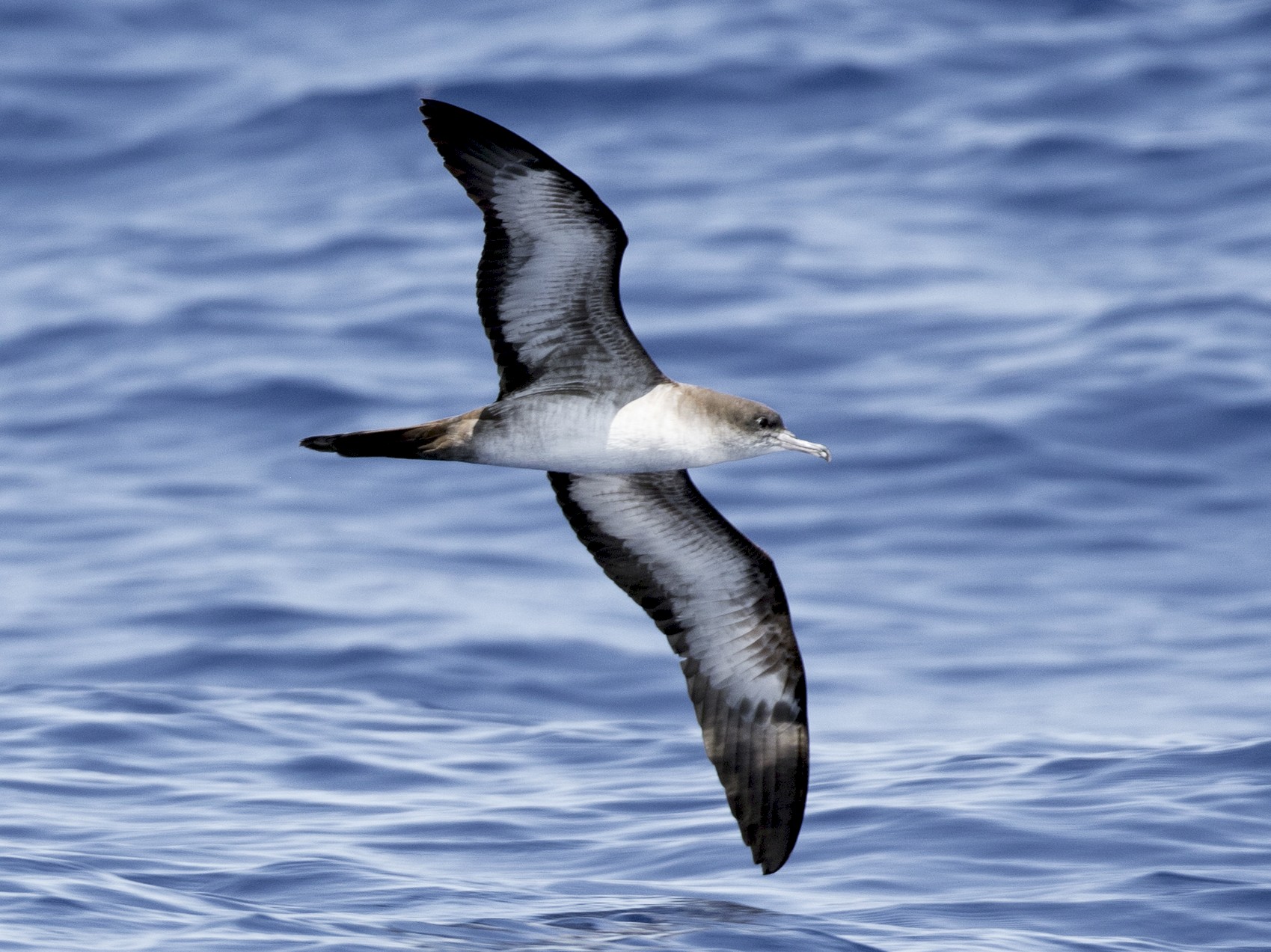
Light-morph Wedge-tailed Shearwater at sea, photograph by Brian Sullivan
Penny Beaver (Institute for Marine and Antarctic Studies, University of Tasmania, Battery Point, Tasmania, Australia) and colleagues have published in the open access journal Ecology and Evolution on the at-sea distribution of two populations of Australian Wedge-tailed Shearwaters Ardenna pacifica.
The paper’s abstract follows:
“Wedge-tailed shearwaters (Ardenna pacifica) are widely distributed across tropical and subtropical oceans, with their breeding range recently extending south. For populations at their southernmost breeding range, habitat use, spatial segregation, and trophic niche dynamics remain poorly understood. Here, we investigated the habitat use, spatial segregation, and trophic niche differentiation in two disjunct populations of wedge-tailed shearwaters in eastern Australia, between 2015 and 2019. Both populations exhibited consistent spatial segregation across all years of the study. Individuals from the temperate population consistently foraged in waters off southeastern Australia. Prior to winter migration to the western Pacific Ocean (Philippine Sea), most individuals undertook a pre-staging detour towards the subtropical frontal zone. In contrast, subtropical conspecifics exploited waters further east and north, with a small proportion undertaking a pre-staging detour only in the first year. Stable isotope analysis of chick feathers (δ15N and δ13C) revealed trophic and habitat segregation between colonies. With the subtropical population consistently occupying a smaller trophic niche area and exhibiting lower interannual variation across all years. Both populations exhibited a high degree of interannual variability in foraging strategies and trophic niches, indicating a capacity for behavioural adaptivity in response to prey availability and oceanic conditions. This behavoural [sic] flexibility may facilitate future range expansion into more southern temperate habitats, which is important given projected climate-driven changes to ocean dynamics in southeastern Australia.”
Reference:
Beaver, P.E., Carlile, N., Sumner, M.D. & Lea, M. 2026. Spatial segregation and trophic niche divergence in two disjunct populations of Wedge‐tailed Shearwater Ardenna pacifica in eastern Australia. Ecology and Evolution 16(3) doi.org/10.1002/ece3.73158.
With apologies to Bob Dylan.
John Cooper, Emeritus Information Officer, Agreement on the Conservation of Albatrosses, 06 May 2026