ACAP Latest News

Read about recent developments and findings in procellariiform science and conservation relevant to the Agreement on the Conservation of Albatrosses and Petrels in ACAP Latest News.

Feather chemical composition in White-chinned Petrels: can it help monitor marine ecosystems?

Alice Carravieri (Centre d’Etudes Biologiques de Chizé, Université de La Rochelle, Villiers-en-Bois, France) and colleagues have published in the Journal Marine Biology on utilizing seabird feathers, including of the ACAP-listed White-chinned Petrel Procellaria aequinoctialis, to assess chemical composition as a way of monitoring marine health.

The paper’s abstract follows:

“One major limitation in the use of body feathers of seabirds as a monitoring tool of the trophic structure and contamination levels of marine ecosystems is the degree of heterogeneity in feather chemical composition within individuals.  Here, we tested the hypothesis that moulting patterns drive body feather heterogeneity, with synchronous moult minimizing within-individual variations, in contrast to asynchronous feather growth.  Chicks of white-chinned petrels Procellaria aequinoctialis (representative of bird chicks) and adults of king penguins Aptenodytes patagonicus (representative of adult penguins) that moult their body feathers synchronously showed very low within-individual variations in their feather δ13C and δ15N values and mercury (Hg) concentrations.  By contrast, body feathers of adults of Antarctic prions Pachyptila desolata (representative of adult seabirds with asynchronous feather growth during a protracted moult) presented much higher within-individual variances for the three parameters.   These findings have three important implications for birds presenting a synchronous body moult.  (1) They suggest that all body feathers from the same individual have identical δ13C and δ15N values and Hg content.  (2) They predict negligible within-individual variations in the body feather values of other useful stable isotopes, such as δ2H and δ34S, as well as in the concentrations of other compounds that are deposited in the keratin structure.  (3) Analysis of one or any number of pooled body feathers is equally representative of the individual.  In conclusion, we recommend that long-term routine monitoring investigations focus on birds presenting synchronous rather than asynchronous moult of body feathers both in marine and terrestrial environments.  This means targeting chicks rather than adults and, for seabirds, penguins rather than adults of flying species.”


White-chinned Petrels, photograph by Ben Phalan

Reference:

Carravieri, A., Buastamante, P., Churlaud, C., Fromant, A. & Cherel, Y. 2014.  Moulting patterns drive within-individual variations of stable isotopes and mercury in seabird body feathers: implications for monitoring of the marine environment.  Marine Biology 161: 963-968.

John Cooper, ACAP Information Officer, 03 September 2014

Lead poisoning appears not to be a threat to Marion Island’s albatrosses and giant petrels

Carly Summers (School of Agricultural, Forest, and Environmental Sciences, Clemson University, South Carolina, USA) and colleagues have looked at lead and cadmium levels in Wandering Diomedea exulans, Light-mantled Sooty Phoebetria palpebrata and Sooty P. fusca Albatrosses and Northern Macronectes halli and Southern M. giganteus Giant Petrels at South Africa’s sub-Antarctic Marion Island, publishing in the Bulletin of Environmental Contamination and Toxicology.

The paper’s abstract follows:

“Levels of lead (Pb) and cadmium (Cd) were investigated as potential stressors in nine species of breeding seabirds on Marion Island, South Africa.  The majority of blood Pb levels (95 %) were below background exposure levels.  Species was a significant factor in ranked means analysis for mean blood Pb levels.  Fewer individual blood Cd levels (<60 %) were within background exposure levels and species was not significant.  Elevated levels of Cd have been documented in other seabird species without apparent outward effects, which suggests that seabirds may be adapted to high cadmium environments, particularly from their diets.  Overall, the results suggest Pb and Cd are not primary causes for concern in these seabirds.”

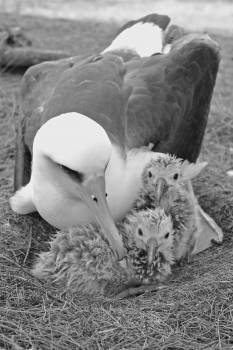
Wandering Albatross and chick on Marion Island, photograph by John Cooper

Reference:

Summers, C.F., Bowerman, W.W., Parsons, N., Chao, W.Y. & Bridges Jr., W.C. 2014.  Lead and cadmium in the blood of nine species of seabirds, Marion Island, South Africa.  Bulletin of Environmental Contamination and Toxicology  DOI 10.1007/s00128-014-1359-6.

John Cooper, ACAP Information Officer, 02 September 2014

Diet of New Zealand’s Antipodean Albatrosses tells us about the distribution of Southern Ocean squid

José Xavier (Department of Life Sciences, Institute of Marine Research, University of Coimbra, Portugal) and colleagues have published in the journal Marine Ecology Progress Series on cephalopods consumed by two different populations of Antipodean Albatrosses Diomedea antipodensis.

The paper’s “pre-press abstract” follows:

“Cephalopods play an important ecological role in the Southern Ocean, being the main prey group of numerous top predators.  However, their basic ecology and biogeography is still poorly known, particularly in the lightly sampled Pacific sector of the Southern Ocean.   We collected and analyzed information on cephalopods in that area, using Antipodean and Gibson´s wandering albatrosses breeding at Antipodes Islands and Auckland Islands, respectively in the New Zealand sub-Antarctic islands as samplers, as they are known from tracking studies to cover huge areas of the Pacific sector of the Southern Ocean (Antipodean wandering albatrosses mostly forage east of New Zealand whereas Gibson´s wandering albatrosses forage west of New Zealand). A total of 9111 cephalopod beaks, from 41 cephalopod taxa, were identified from boluses (voluntarily regurgitated items by chicks).  The families Histioteuthidae (e.g. Histioteuthis atlantica) and Onychoteuthidae (e.g. Moroteuthis robsoni) were the most important cephalopods numerically and by reconstructed mass, respectively, in both wandering albatross species.  Combining this information with previously gathered data on cephalopods in the Atlantic and Indian sectors of the Southern Ocean, we provide evidence from predators of the circumpolar distribution of numerous key cephalopod species have in the Southern Ocean, and provide new information on poorly known cephalopods (i.e. relevance in the diet of wandering albatrosses, sizes consumed, biodiversity in the South Pacific, assemblages according to predator breeding sites) in one of the most remote ocean areas in the planet.”


Antipodean Albatross, photograph by Colin O'Donnell

Reference:

Xavier, J.C., Walker, K., Elliot, G., Cherel, Y. & Thompson, D. 2014.  Cephalopod fauna of South Pacific waters: new information from breeding New Zealand wandering albatrosses.  Marine Ecology Progress Series doi: 10.3354/meps10957.

John Cooper, ACAP Information Officer, 01 September 2014

Over half the plastic items swallowed by Laysan Albatrosses are made of infrequently recycled Polypropylene

Frances Nilsen (Hawai’i Pacific University, Kane’ohe, Hawaii, USA) and colleagues have looked at the various types of plastic ingested by Laysan Albatrosses Phoebastria immutabilis, publishing in the Marine Pollution Bulletin.

The paper’s abstract follows:

“Laysan albatross (Phoebastria immutabilis) ingest plastic marine debris of a wide range of shape, sizes and sources.  To better characterize this plastic and provide insights regarding its provenance and persistence in the environment, we developed a simple method to classify plastic fragments of unknown origin according to the resin codes used by the Society of Plastics Industry.  Known plastics were analyzed by gas chromatography–mass spectroscopy (GC–MS) to identify indicator chemicals characteristic of each plastic resin.  Application of this method to fragments of ingested plastic debris from boluses of Laysan albatross from Kure Atoll, Hawai’i, yielded proportions of 0.8% High Density Polyethylene, 6.8% Polystyrene, 8.5% Polyethylene Terephthalate, 20.5% Polyvinyl Chloride and 68.4% Polypropylene.  Some fragments were composed of multiple resin types.  These results suggest that infrequently recycled plastics are the dominant fragments ingested by albatross, and that these are the most prevalent and persistent resin types in the marine environment.”

Laysan Albatross, photograph by Peter Leary

Reference:

Frances Nilsen, F., Hyrenbach, K.D., Fang, J. & Jensen, B.2014.  Use of indicator chemicals to characterize the plastic fragments ingested by Laysan albatross.  Marine Pollution Bulletin DOI: 10.1016/j.marpolbul.2014.07.055.

John Cooper, ACAP Information Officer, 31 August 2014

Prolonged handling of Short-tailed Albatross chicks causes muscle damage and behavioural changes

Tomohiro Deguchi (Division of Avian Conservation, Yamashina Institute for Ornithology, Japan) and colleagues have published in the Journal of Wildlife Management on the deleterious effects of handling Short-tailed Albatross Phoebastria albatrus chicks.

The paper’s abstract follows:

“Capture and handling are essential methods for many studies of wild animals but can induce several harmful effects on individuals being studied.  The relationship between physiological and behavioral responses in individuals exposed to these effects is not well known.  We measured the blood level of muscle enzymes, aspartate aminotrasnsferase (AST) and creatine kinase (CK), indicating muscle damage in hand-reared short-tailed albatross (Phoebastoria albatrus) chicks before and after prolonged restraint for transmitter attachment beyond the usual feeding.  We analyzed the relationships between enzyme levels and albatross pre- and post-fledging behaviors.  Prolonged restraint for transmitter attachment elevated the blood levels of AST and CK in chicks.  In chicks with higher levels of these enzymes, fledging date was earlier and the period to sustained flight after fledging was longer.  These results indicated that prolonged handling for transmitter attachment on pre-fledging albatross chicks caused moderate muscle damage and behavioral changes before and after fledging.  Although immediate post-fledging survival (the first 2 weeks at sea) did not appear to be affected, whether longer-term survival may be influenced is unknown.  Reducing handling time for albatross chicks is important to reduce muscle damage and behavioral consequences.”

A Short-tailed Albatross chick gets a satellite transmitter

Photographs by Tomohiro Deguchi

With thanks to Tomohiro Deguchi for information and photographs.

Reference:

Deguchi, T., Suryan, R.M. & Ozaki, K. 2014.  Muscle damage and behavioral consequences from prolonged handling of albatross chicks for transmitter attachment.  Journal of Wildlife Management DOI: 10.1002/jwmg.765.

John Cooper, ACAP Information Officer, 30 August 2014

The Agreement on the
Conservation of Albatrosses and Petrels

ACAP is a multilateral agreement which seeks to conserve listed albatrosses, petrels and shearwaters by coordinating international activity to mitigate known threats to their populations.

About ACAP

ACAP Secretariat

119 Macquarie St
Hobart TAS 7000
Australia

Email: secretariat@acap.aq
Tel: +61 3 6165 6674