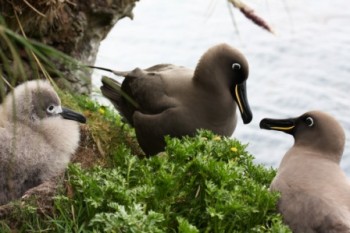
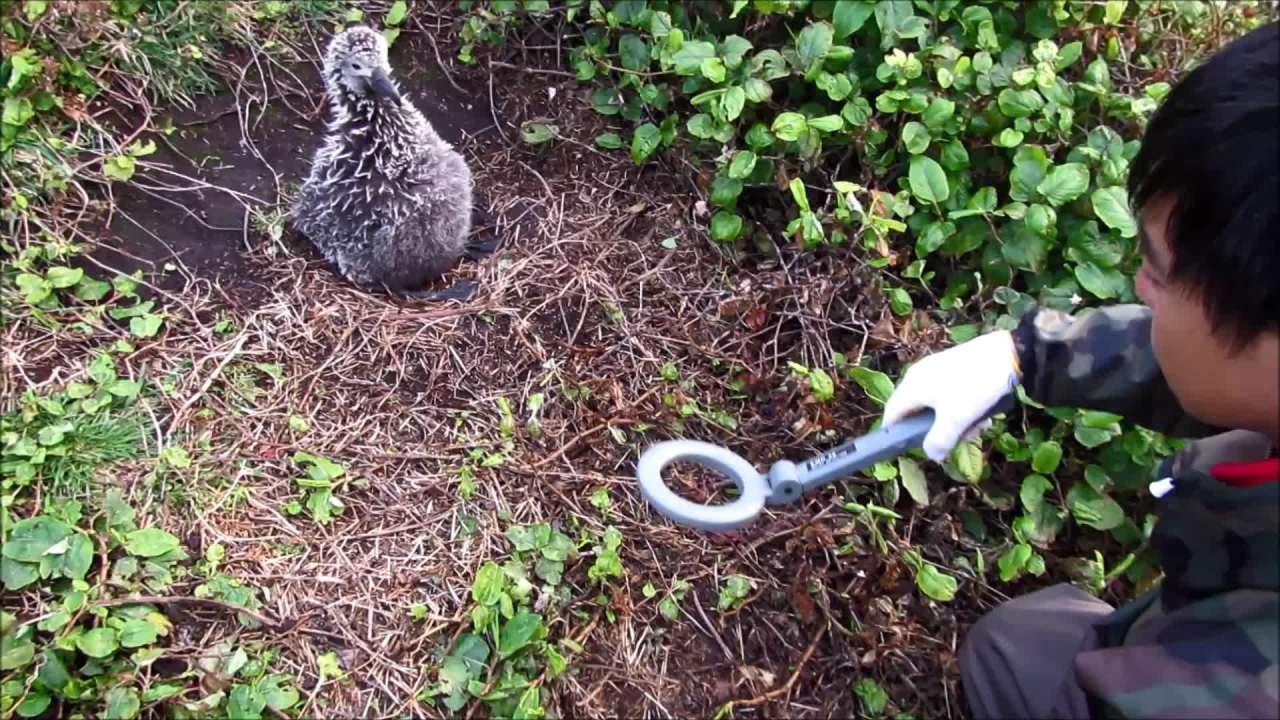
With thanks to Michelle Jones for her photograph of a curious Sooty Albatross Phoebastria fusca at Marion Island
Marco Favero, Wiesława Misiak & John Cooper, ACAP Secretariat, 25 December 2017
7
7
Read about recent developments and findings in procellariiform science and conservation relevant to the Agreement on the Conservation of Albatrosses and Petrels in ACAP Latest News.


With thanks to Michelle Jones for her photograph of a curious Sooty Albatross Phoebastria fusca at Marion Island
Marco Favero, Wiesława Misiak & John Cooper, ACAP Secretariat, 25 December 2017
7
7
Philipp Boersch-Supan (Department of Geography, University of Florida, Gainesville, USA) and colleagues have published in the journal Emu Austral Ornithologyon albatross egg temperatures.
The paper’s abstract follows:
“Knowledge of thermal traits is essential for understanding and modelling physiological responses to environmental change. Egg temperatures are poorly studied in most tubenose species. We employed a contactless infrared thermometer to measure egg and nest surface temperatures throughout the incubation period for four albatross species at Bird Island, South Georgia. The observed mean warm-side temperature of 33.4°C for Wandering Albatross (Diomedea exulans) was similar to measurements obtained from this species using dummy eggs elsewhere. Observed mean warm-side temperatures for Black-browed Albatross (Thalassarche melanophris), Grey-headed Albatross (Thalassarche chrysostoma), and Light-mantled Albatross (Phoebetria palpebrata), reported here for the first time, were 30.7–31.5°C, which is lower than the egg temperatures reported for most Procellariiformes. Temperature gradients across viable eggs declined by up to 9°C during incubation, reflecting increased embryonic circulation and metabolic heat production. This suggests that bioenergetic models should not assume constant egg temperatures during embryo development. Non-viable (addled) eggs could be identified by large temperature gradients in late incubation, indicating that infrared thermometry can be used to determine whether the embryo has died or the egg is infertile in monitoring and managed breeding (e.g. translocation) programmes. Egg temperatures were correlated with ground temperatures, indicating that incubated eggs are vulnerable to environmental variability.”

An incubating Wandering Albatross on Marion Island, photograph by Linda Clokie
With thanks to Richard Phillips.
Reference:
Boersch-Supan, P.H., Johnson, L.R., Phillips, R.A. & Ryan, S.J. 2017. Surface temperatures of albatross eggs and nests. Emu Austral Ornithology doi.org/10.1080/01584197.2017.1406311.
John Cooper, ACAP Information Officer, 22 December 2017
Ivan Tiunov (Federal Scientific Center of the East Asia Terrestrial Biodiversity, Vladivostok, Russia) and colleagues have published in the Journal of Asia-Pacific Biodiversity on the at-sea distribution of a Russian population of the globally Near Threatened Streaked Shearwater Calonectris leucomelas.
The paper’s abstract follows:
“Karamzin Island (the Peter the Great Bay, the East Sea) is the only nesting point of streaked shearwaters in Russian Federation. To understand and determine distribution patterns of streaked shearwaters along the Eastern Sea waters during nesting period, the Trackers WT-300 were set to 10 adult birds. Over the observation period (from 5 July 2016 to 7 January 2017), 4812 locations were registered. Analysis of data obtained revealed that main feeding points of colony studied were situated in the Peter the Great Bay along 50 m isobath and, to the less extension, near the eastern coast of Korean Peninsula. It was determined that streaked shearwaters most frequently visited waters with circular flows or zones of junctions of multidirectional flow. It was also shown that these zones had high concentrations of zooplankton.”

Streaked Shearwater at sea
Reference:
Tiunov, I., Katin, I., Lee, H., Lee, S. & Im, E. 2017. Foraging areas of streaked shearwater Calonectris leucomelas nesting on the Karamzin Island (Peter the Great Bay, East Sea). Journal of Asia-Pacific Biodiversity doi.org/10.1016/j.japb.2017.10.005.
John Cooper, ACAP Information Officer, 21 December 2017
The ACAP-listed Antipodean Albatross Diomedea antipodensis, endemic to New Zealand, has been uplisted from Vulnerable to Endangered in the 2017 update of the IUCN Red List of Threatened Species due to very rapid population decreases at both its main breeding sites on the Antipodes and Auckland Island Groups since 2004.
Click here for BirdLife International’s assessment for the Antippodean Albatross.

Antipodean Albatross on Adams Island, Aucklands; photograph by Colin O'Donnell
Because of its worsening conservation status the Agreement added the population of the Antipodean Albatross of the nominate subspecies that breeds on Antipodes Island to the list of ACAP priority populations for conservation management at a meeting of its Advisory Committee, held in Wellington, New Zealand, this September (click here).
Another New Zealand endemic, the ACAP-listed Westland Petrel Procellaria westlandica, has also been uplisted from Vulnerable to Endangered. BirdLife states that “this species qualifies as Endangered because it is restricted to one very small area when breeding, and its habitat is declining in quality due to erosion and landslips.”
Better conservation news is that ACAP-listed Black-browed Albatross Thalassarche melanophris has been downlisted from Near Threatened to Least Concern in the 2017 Red List due to an increasing population trend for a species with a very large range in the Southern Ocean and a large global population estimated by BirdLife International as 1.4 million individuals.
John Cooper, ACAP Information Officer, 20 December 2017
The UK’s Royal Society for the Protection of birds (RPSB) is looking for a a Project Officer to work at its headquarters with BirdLife International’s Albatross Task Force, a team of seabird bycatch instructors helping fishers in South America and southern Africa to limit their impact on albatrosses and other threatened seabirds
“The job involves liaising directly with project partners to deliver ambitious programme goals to reduce seabird bycatch, and as such requires cultural sensitivity, partnership building abilities and strong Spanish language skills, which will be tested at interview.
This position would suit knowledgeable and enthusiastic early career scientists looking to apply their skills to a marine conservation project aimed at making a meaningful impact.”
Closing date for receipt of applications is 5 January 2018.

Read more here.
John Cooper, ACAP Information Officer, 19 December 2017
© 2024 ACAP. All rights reserved. Privacy Policy Manage Your Data LoginLogout