
 English
  Français
  Español
 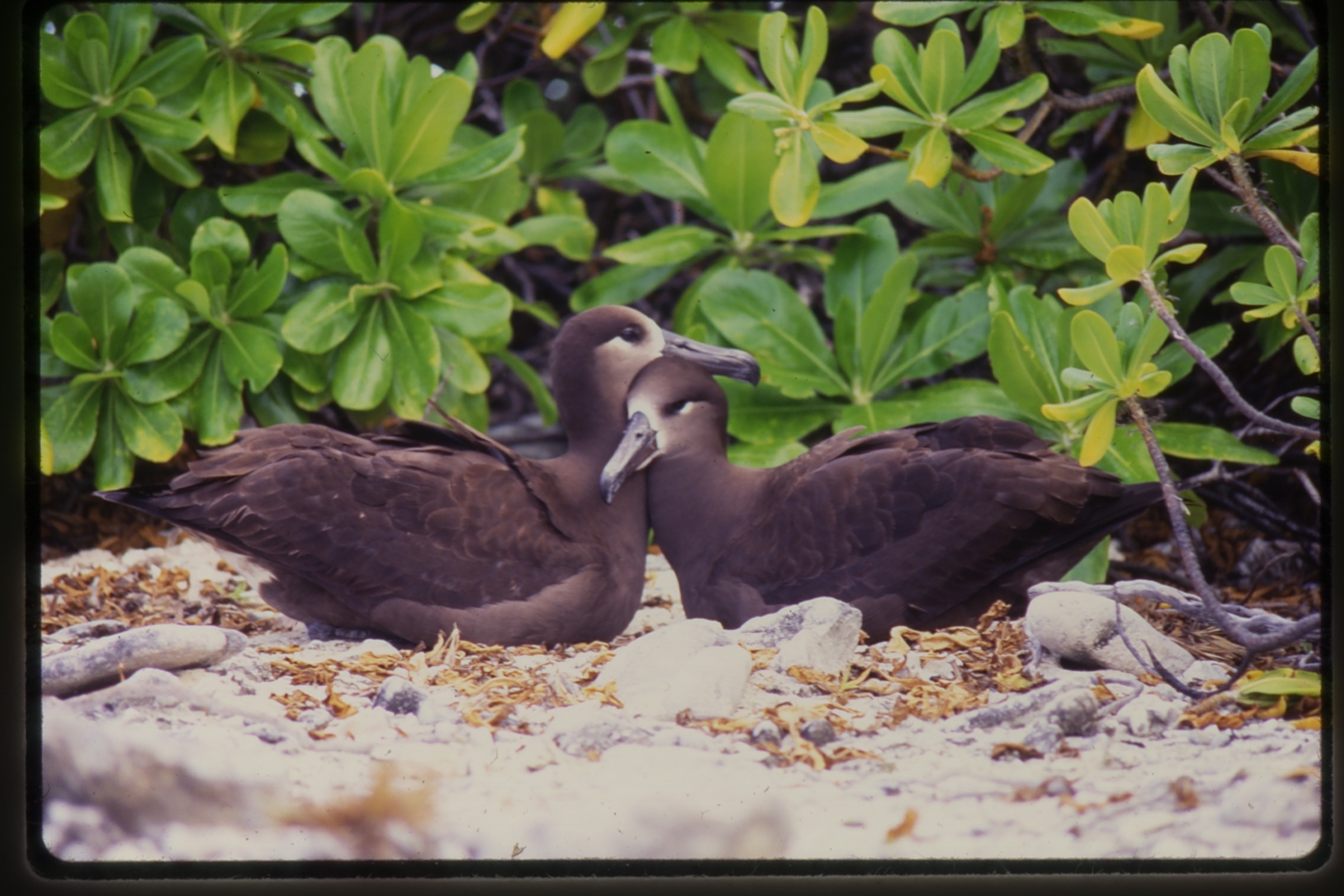 A Black-footed Albatross pair on Wake Atoll, photograph by Mark Rauzon
The USA’s Wake Atoll in the tropical Pacific has recently been proclaimed as free of introduced rodents, following a successful eradication exercise directed at the Pacific Rat Rattus exulans. There are already signs of seabirds returning, including the ACAP-listed Black-footed Phoebastria nigripes and Laysan P. immutabilis Albatrosses (both Near Threatened):
“16 species of nesting native birds are reappearing and increasing in number without invasive rodents devouring their eggs and young. A newly discovered Bonin Petrel (or Nunulu in Hawaiian) colony marks the first documented nesting of this species on Wake Atoll, while the atoll’s globally significant population of Sooty Terns enjoyed a record-breaking breeding season. Other native seabirds—including Laysan albatross, wedge-tailed and Christmas shearwater, black-footed albatross, red-footed booby, and red-tailed tropicbird—are also showing early signs of increased nesting activity and improved reproductive success”.
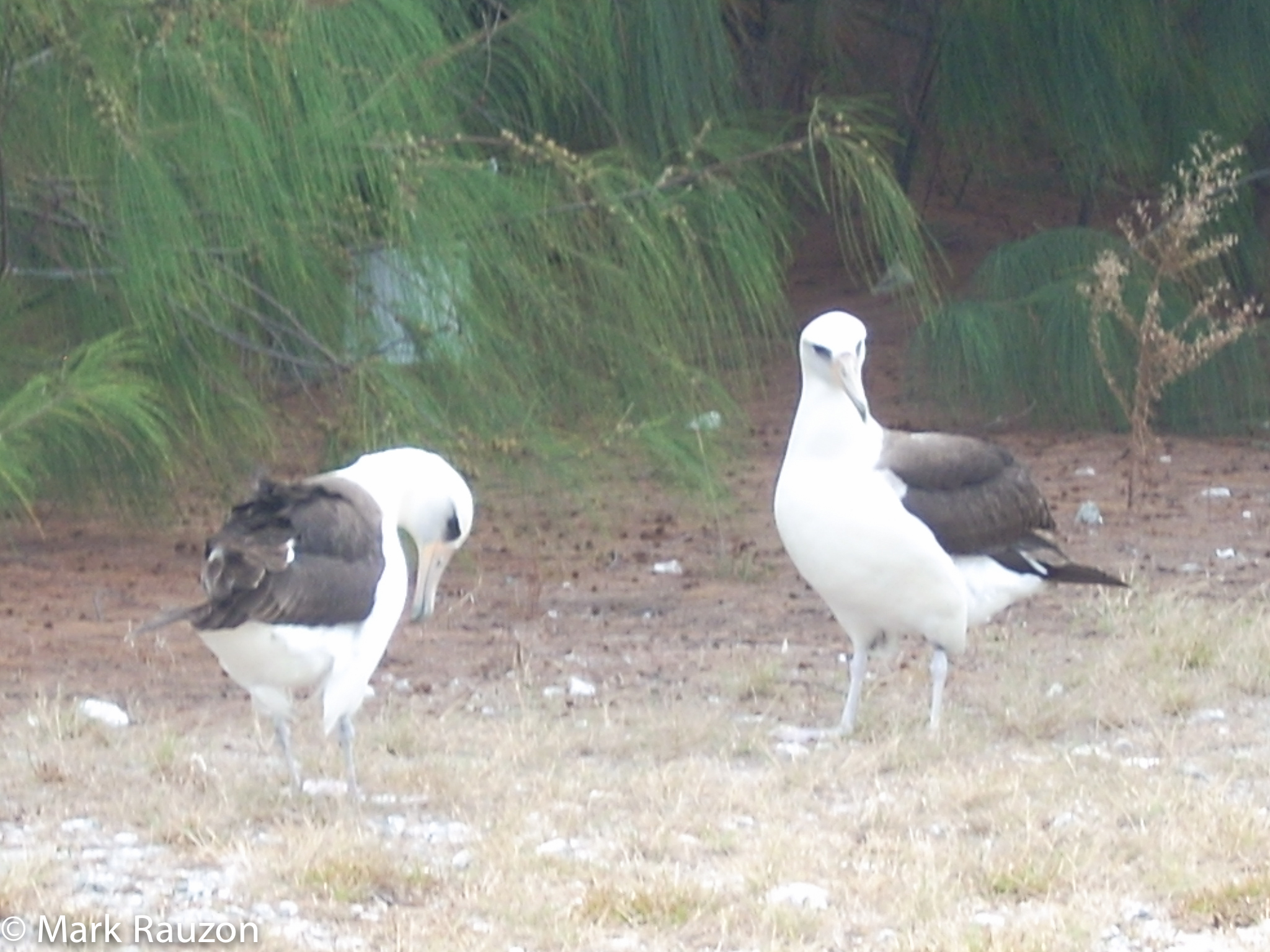 Laysan Albatrosses on Wake Atoll, photograph by Mark Rauzon
Wake Atoll lies towards the edge of the current breeding range of the Black-footed and Laysan Albatrosses. The first definite breeding record for the Laysan was in 1996, following sightings in the 1980s. A chick fledged in 2001 and there were three failed attempts in 2008. Another chick, the last recorded, successfully fledged in 2009. A Laysan Albatross laid an egg in November 2013 below an introduced Ironwood Casuarina equifolia tree that was incubated for two weeks before failing. A second egg found in 2013 was also abandoned.
Black-footed Albatrosses visit Wake in small numbers. Successful breeding has not been reported although eggs have been recorded occasionally since 1996 and up to at least 2003, when three pairs attempted breeding (click here),
Wake Atoll (739 ha) is made up of three low coral islands: Wake Wilkes and Peale, lying around a central lagoon. Wake and Wilkes are connected by a causeway. The atoll is situated within Micronesia in the Northern Pacific Ocean a little north of the Marshall Islands and is an unorganized, unincorporated territory of the USA. It falls within the Pacific Remote Islands Marine National Monument declared in 2009.
“Feral domestic cats Felis catus originally brought to the atoll as pets killed many birds (estimated as 30 000 a year) in the past on Wake but have now been successfully eradicated from all three islands. A shooting and trapping campaign in the first decade of the century removed 170 animals. An eradication attempt in 2012 was successful in removing the Asian House Rat Rattus tanezumi but not the Pacific Rat R. exulans” (click here).
Wake Atoll Rat Eradication Project - Using research to eradicate the novel rodent species, Neotoma leucodon
The successful effort to eradicate Pacific Rats presumably also removed the recently discovered White-throated Woodrat Neotoma albigula/leucodon, although this seems not to have been specifically reported.
With thanks to Sue Tonin, Mouse-Free Marion Project.
Selected References:
Griffiths, R., Wegmann, A., Hanson, C., Keitt, B, Howald, G., Brown, D., Tershy, B., Pitt, W., Moran, M., Rex K., White, S., Flint, B. & Torr, N. 2014. The Wake Island rodent eradication: part success, part failure, but wholly instructive. Proceedings of Vertebrate Pest Conference 26: 101–111.
Hanson, C., Rex, K., Kappes, P.J. & Siers, S.R. 2020. Feasibility of a successful rat eradication on Wake Atoll following initial partial failure: potential causes, remedial actions, and remaining knowledge gaps. In: Woods, D.M. (Ed.), Proceedings of the 29th Vertebrate Pest Conference, Paper No. 40, University of California, Davis, 9 pp.
Kappes, P.J., Siers, S.R., Rex K. & Hanson, C. 2020. If at first you don’t eradicate: remediating rat eradication failure on Wake Atoll. In: Woods, D.M. (Ed.). Proceedings of the 29th Vertebrate Pest Conference, Paper No. 58, University of California, Davis, 6 pp.
Piaggio, A.J., Lanners, E., Taylor, D.R., Shiels, A.B., Matocqm, M. & Eisemann, J. 2024. Discovery of a novel invasive rodent species on Wake Atoll with a desert southwest USA origin. BioInvasions Records 13: 675-683.
Rauzon, M.J, Everett, W.T., Boyle, D., Bell, L. & Gilardi, J. 2008. Eradication of feral cats at Wake Atoll. Atoll Research Bulletin No. 560. 21 pp.
Samaniego, A., Kappes, P., Broome, K., Cranwell, S., Griffiths, R., Harper, G., McClelland, P., Palmer, R., Rocamora, G., Springer, K., Will, D. & Siers, S. 2020. Lessons learned from failed island rodent eradications redone successfully: Implications for the second rat eradication attempt on Wake Atoll. Unpublished Final [Report]. 85 pp.
John Cooper, Emeritus Information Officer, Agreement on the Conservation of Albatrosses and Petrels, 30 April 2026