
 English
  Français
  Español
 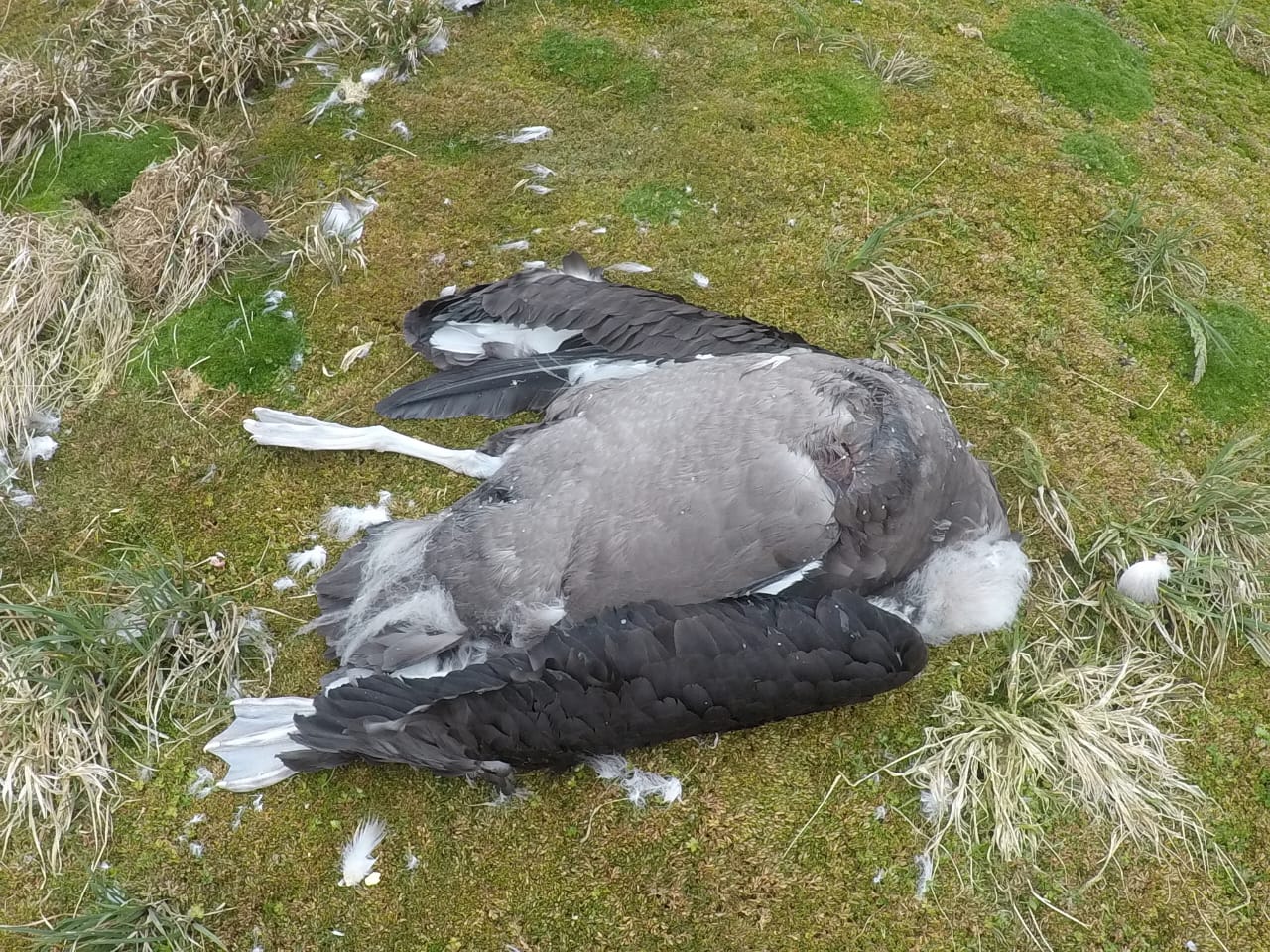 A Wandering Albatross chick that succumbed to High Pathogenicity Avian Influenza on Marion Island in November 2024, photograph by Rhiannon Gill
Ralph Vanstreels (Karen C. Drayer Wildlife Health Center, University of California - Davis, USA) and colleagues have published in the Biodiversity Data Journal on the work of the ACAP Intersessional Correspondence Group of Experts on Epidemiology, Disease Risk Assessment and Management. The Group advises the Albatrosses and Petrel Agreement on issues related to the ongoing high pathogenicity H5Nx avian influenza panzootic.
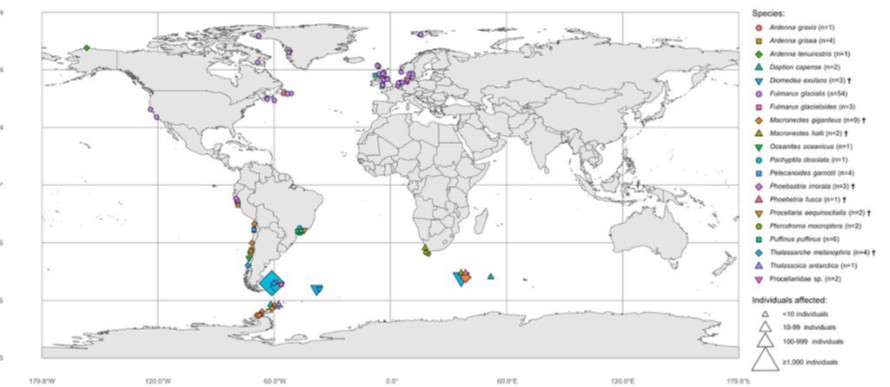 Geographic distribution of confirmed HPAI events in procellariiform birds. HPAI events are with coloured symbols by species (shape and colour) and number of individuals affected (size). The total number of confirmed HPAI events recorded for each species is indicated in the legend (n). Dagger symbols (†) indicate species listed in Annex 1 of the Agreement on the Conservation of Albatrosses and Petrels (ACAP). Data updated as of 31 December 2025 (from the publication)
The paper's abstract follows:
“High pathogenicity avian influenza (HPAI) viruses have rapidly emerged as a major global threat to wildlife, with severe consequences for seabird populations. Albatrosses and petrels (order Procellariiformes) are particularly vulnerable due to their long lifespan, low reproductive rates and strong site fidelity. Since 2021, HPAI viruses have caused unprecedented mortality in seabird communities worldwide and have expanded into the core range of procellariiform species, including sub-Antarctic and Antarctic regions.
In response to the urgent need for timely, species-relevant information, the Agreement on the Conservation of Albatrosses and Petrels (ACAP) established the High Pathogenicity H5Nx Avian Influenza Intersessional Correspondence Group (HPAI-ICG), which developed the ACAP HPAI database — an openly accessible, regularly updated resource that consolidates all known suspected and confirmed HPAI events involving procellariiform birds. The database compiles information from global and national reporting systems, scientific literature, genetic repositories, government communications and direct expert notifications. Events are standardised using transparent case definitions, cross-referenced and validated by subject-matter experts and complemented by additional data on case impacts and viral characteristics. The database provides a critical decision-support tool for governments, researchers, conservation practitioners and tourism operators, contributing to the planning and implementation of HPAI biosafety, surveillance, monitoring and outbreak response activities.”
With thanks to Patricia Serafini.
Reference:
Vanstreels, R.E.T., Serafini, P.P., Giacinti J., Younger, J., Huyvaert, K.P., Wille, M., Roberts, L., Gamble, A. & Uhart, M.M. 2026. A public database to monitor the spread and impacts of high pathogenicity avian influenza viruses on albatrosses and petrels. Biodiversity Data Journal 14. e186836.
John Cooper, Emeritus Information Officer, Agreement on the Conservation of Albatrosses and Petrels, 19 May 2026