
 English
  Français
  Español
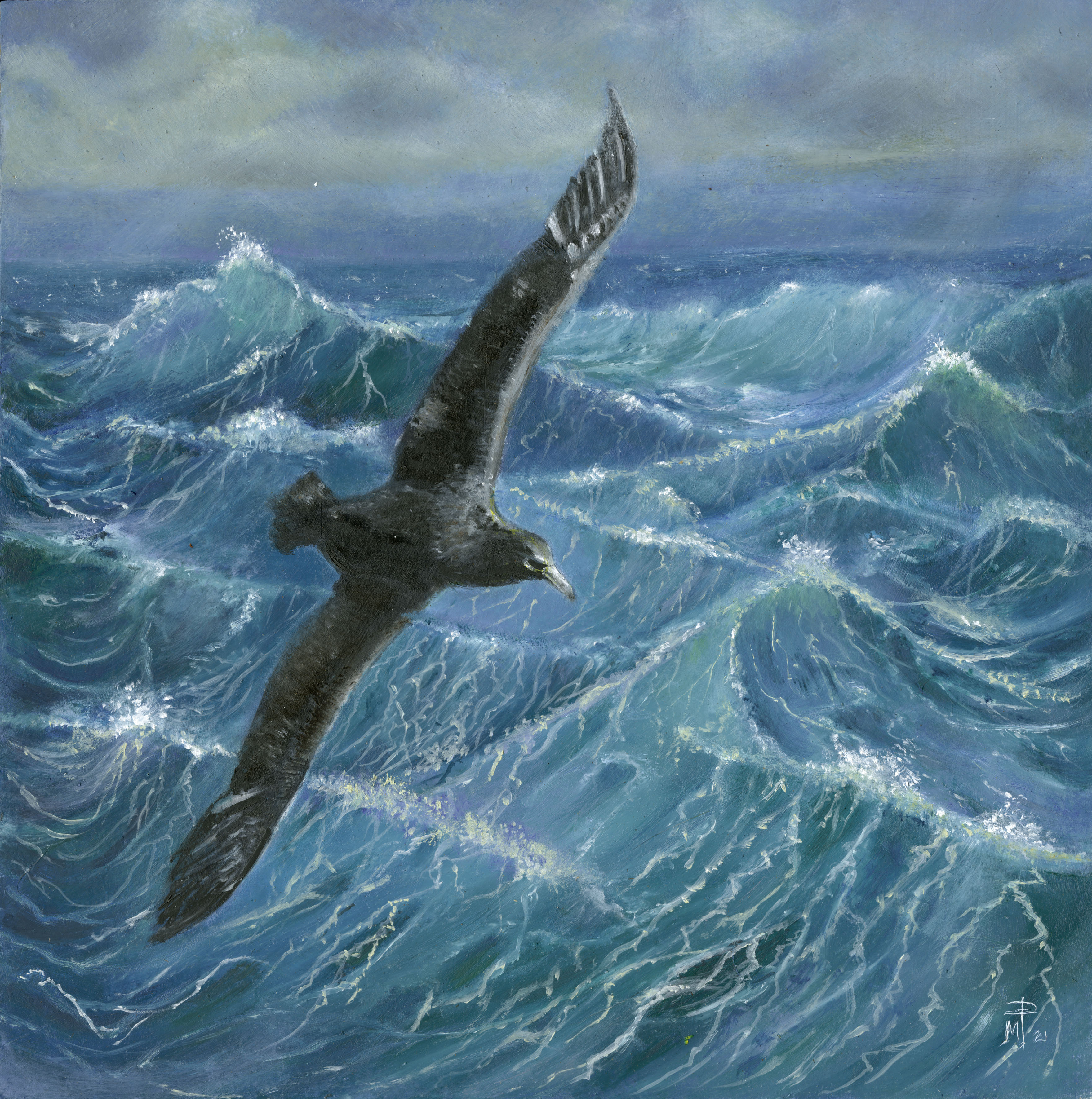 Southern Giant Petrel at sea in rough weather, oil painting by Mark Price, Artists & Biologists Unite for Nature (ABUN) for ACAP’s “Petrels in Peril” project in 2021, after a photograph by Laurie Smaglick Johnson
Madeline Hallet (School of Marine and Atmospheric Sciences, Stony Brook University, New York, USA) and colleagues have published open access in the journal Functional Ecology on aspects of flight in giant petrels Macroncetes spp
The paper’s abstract follows:
- “Wind is a major factor driving seabird movement and energetics, the effects of which are modulated by morphology. Developments in tagging technology now make it possible to test predictions from aerodynamic theory about the effects of wind on flight performance in free-ranging birds. Waves are also thought to have a strong influence on seabird movement but have received less attention.
- We investigated the interplay between wind, waves, and morphology and tested predictions of flight theory in giant petrels (Macronectes spp.), which show greater sexual size dimorphism than any other seabird. We quantified flapping rates as a proxy of energy expenditure using accelerometers deployed on northern giant petrels (M. halli; n = 45) and southern giant petrels (M. giganteus; n = 48) breeding at Bird Island, South Georgia in 2022 and 2023. Wind and waves experienced by birds tracked with Global Positioning System (GPS) loggers were integrated with ERA5 reanalysis data to assess how flapping rates and ground speeds, respectively, were influenced by wind and waves. Using generalized additive mixed models, we predicted the spatial distribution of suitable habitat for soaring based on wind and wave conditions.
- Both wind and waves strongly influenced flight energetics; flapping rates decreased with increasing wind speed and swell height in all species and sexes. Together, wind and waves allowed giant petrels to reduce flapping rates by 76% to 91%. Wind also influenced the speed of travel; ground speed increased with wind speed in tail- and crosswinds, but generally decreased with wind speed in headwinds.
- Male giant petrels had higher wing loadings, and as predicted by flight theory, required higher air speeds for soaring flight and had higher flapping rates than females. Potential soaring habitat was much more limited for male than for female giant petrels, suggesting that differences in flight energetics between sexes may contribute to sexual segregation in foraging areas.
- Our results demonstrate how morphology, wind and waves combine to influence the flight energetics of giant petrels. Understanding the interactions among these factors is central to understanding environmental drivers of seabird distribution and to predicting responses to continued climate change.”
With thanks to Richard Phillis, British Antarctic Survey.
Reference:
Hallet, M.E., Phillips, R.A., Maywar, I.J. & Thorne, L.H. 2026. Wind, waves, wing loading and the flight energetics of giant petrels. Functional Ecology doi/10.1111/1365-2435.70352.
John Cooper, Emeritus Information Officer, Agreement on the Conservation of Albatrosses and Petrels, 14 May 2026