
 English
 Français
 Español
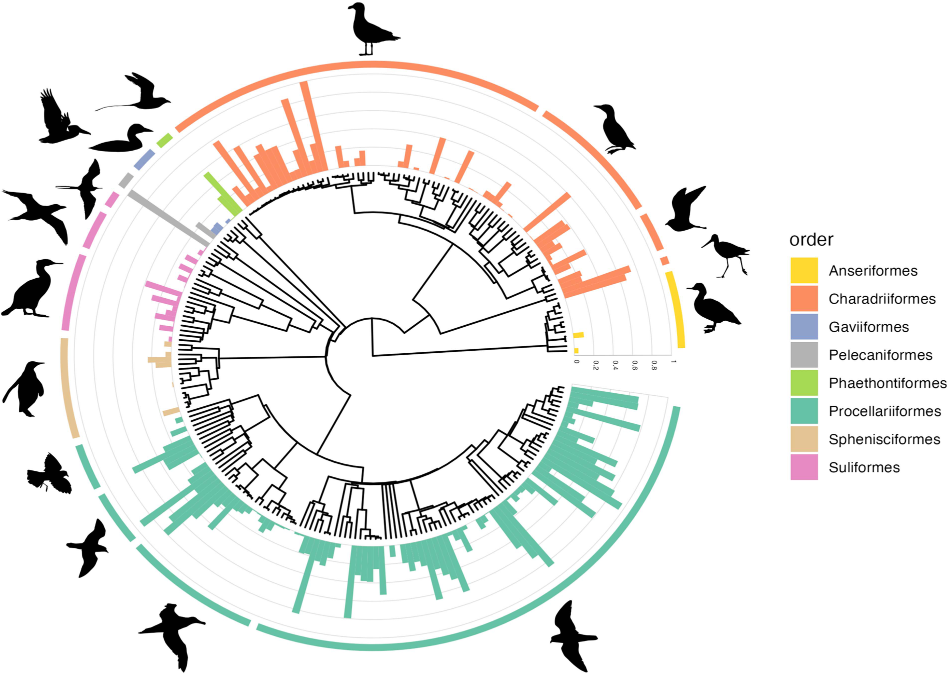 Frequency of occurrence of plastic in seabirds, from the publication
Stephanie Avery-Gomm (School of Biological Sciences, University of Queensland, Brisbane, Australia) and colleagues have published open access in the journal Biology Letters on the frequency of occurrence of ingested plastic material in 93 281 individual seabirds representing 240 species.
The paper’s abstract follows:
“Seabirds are especially vulnerable to ingesting plastic pollution. However, we have a limited understanding of which traits might increase their risk of plastic ingestion. Here, we use a dataset of seabird plastic occurrence records (93 281 birds from 240 species) to investigate which species accumulate plastic and whether this is related to diet, foraging method, pelagic specialism, body mass or phylogenetic position. In our dataset, 182 of the 240 species (76%) contained plastic. Within orders, the highest levels were in pelicans (Pelecaniformes; 67%) and the lowest in penguins (Sphenisciformes; 5%). In our phylogenetically informed analysis, accounting for artefacts of study design (e.g. sample size, year, ocean, source, age class and sampling method), none of the ecological traits we tested had a consistent effect on plastic occurrence. Instead, phylogenetic relatedness was the best predictor in our models, reflecting the tight correlation between seabird phylogenetic groupings and their traits. This suggests that phylogenetic position may serve as a rapid way to identify species likely to accumulate plastic. Future research should focus on developing predictions of plastic accumulation risk for understudied species, implementing standardized methodologies and investigating species-specific morphological and environmental variables that may affect their risk of plastic accumulation.”
With thanks to Alex Bond.
Reference:
Avery-Gomm, S., Potapova, N., Potter, C., Bond, A.L., Borrelle, S.B., Lavers, J.L., Portugal, S.J., Possingham, H., Provencher, J. & Cooper, N. 2026. Frequency of plastic occurrence varies across phylogeny but not ecology in seabirds. Biology Letters 22 (10): 20260079.
John Cooper, Emeritus Information Officer, Agreement on the Conservation of Albatrosses and Petrels, 21 October 2026