
 English
  Français
  Español
 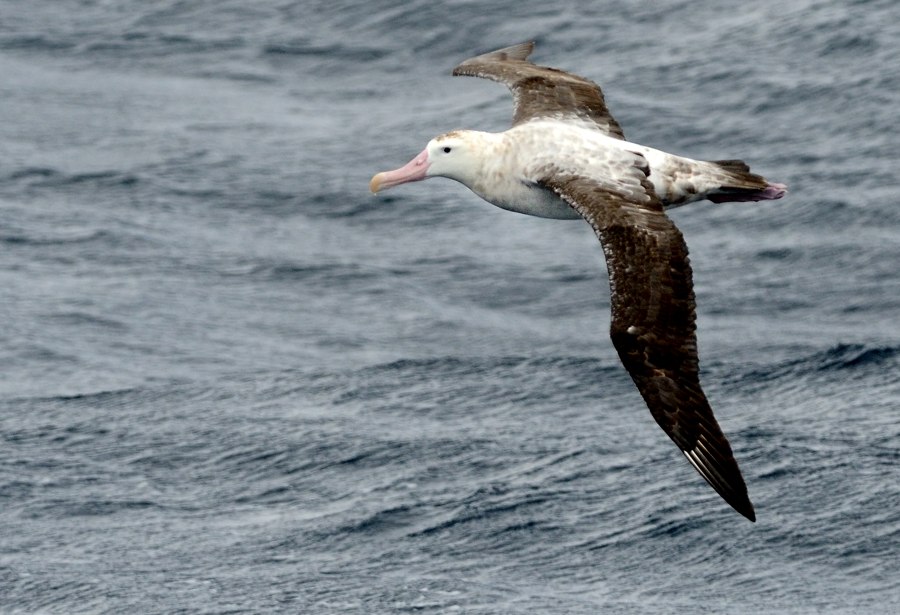 A Wandering Albatross in the southern Indian Ocean, photograph by Kirk Zufelt
Ruijiao Sun (Biology Department, Woods Hole Oceanographic Institution, Massachusetts, USA) and colleagues have published in Geophysical Research Letters on the relationship between westerly winds from subtropical anticyclones and Wandering Albatrosses Diomedea exulans.
The paper’s abstract follows:
“Subtropical anticyclones are semi-permanent atmospheric high-pressure systems located in all five major ocean basins and are associated with large-scale wind and weather patterns. They shape the physical environments of many species, yet their impacts on wildlife remain effects of the Mascarene High, the Southern Indian Ocean subtropical anticyclone, on a wind-reliant marine top predator. Using 39 years of population data for wandering albatrosses (Diomedea exulans) breeding in the Southern Indian Ocean, we explored the mechanisms linking variability in the subtropical anticyclone to demographic rates. We found that an intensified and poleward-shifted Mascarene High toward Antarctica enhances westerly winds, increasing survival and reproduction probability across all life stages of wandering albatrosses. These findings uncover a direct link between subtropical anticyclones and population dynamics, highlighting subtropical anticyclones as important drivers of the responses of wind-reliant taxa to climate variability and change.”
Reference:
Sun, R., Rouby, E., Barbraud, C., Weimerskirch, H., Delord, K., Krumhardt, K., Ventura, F., Ummenhofer, C.C. & Jenouvrier, S. 2026. Mascarene high variability shapes the demography of a wind-reliant marine top predator. Geophysical Research Letters 53, e2026GL122317.
John Cooper, Emeritus Information Officer, Agreement on the Conservation of Albatrosses and Petrels, 23 June 2026