
 English
  Français
  Español
 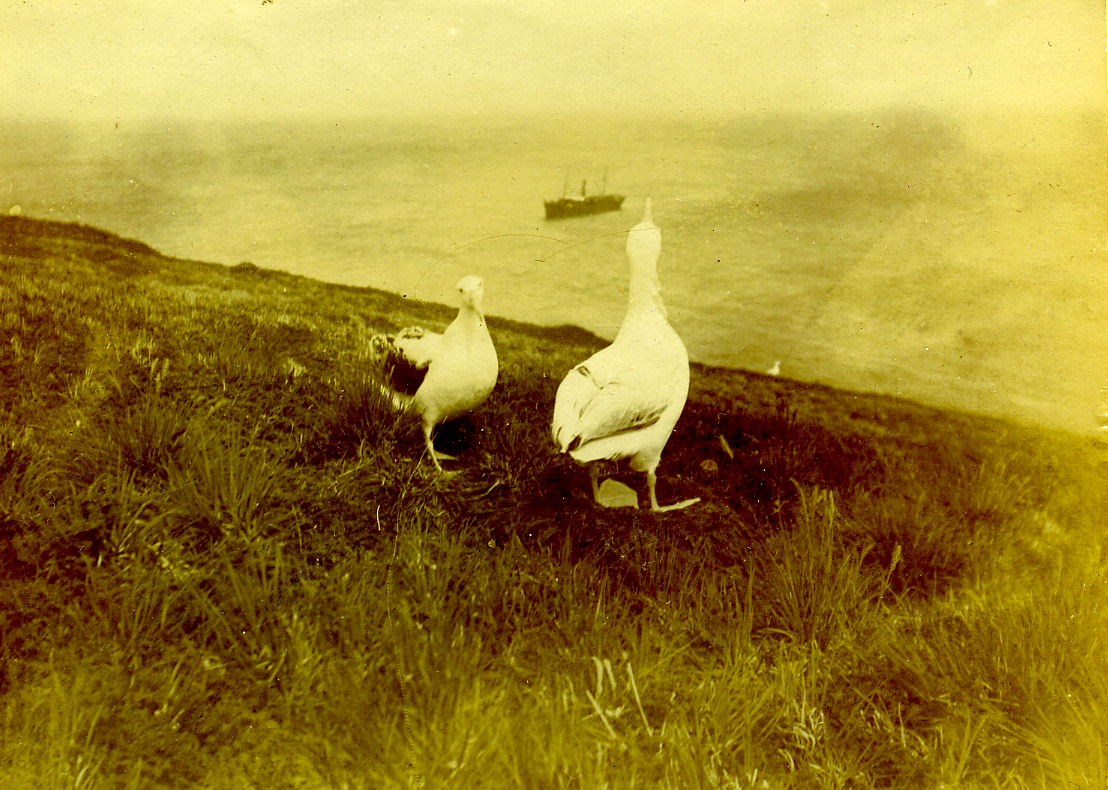 First photo from the Crozets? Wandering Albatrosses on Possession Island, summer 1907/08, photograph by Anders Harboe Ree
Joanie Van de Walle (Département de biologie, chimie et géographie, Université du Québec à Rimouski, Canada) and colleagues have published on boldness in Vulnerable Wandering Albatross Diomedea exulans open access in the journal Oikos.
The paper’s abstract follows:
“Population dynamics are shaped by individual differences. With a good understanding of the relationships between individual differences and vital rates, population models can be improved to yield more realistic and detailed demographic projections. Personality is expected to shape individual differences in performance. Yet, an empirical quantification of its impact on population dynamics is currently lacking. Here, we developed and analyzed a three-dimensional hyperstate population model that accounts for three sources of individual differences simultaneously in its structure: age, breeding state and boldness as a measure of personality. We parameterized our model using empirical demographic and boldness data on the wandering albatross Diomedea exulans population from Crozet. We quantified the relative importance of boldness through sensitivity analyses and simulations of increased strength of relationship between boldness and three vital rates (survival, breeding probability and breeding success). We showed that sensitivity of population growth rate to changes in vital rates followed the normal distribution of boldness within the population with population growth rate being less sensitive to changes in the vital rates of extreme shy or bold individuals. Our simulations showed that increasing the strength of the relationship between boldness and survival would yield the greatest shift in boldness distribution over time compared to breeding probability and breeding success. However, shifts in boldness distribution appeared constrained by the low heritability (< 0.2) value and the large variance in boldness in this population. Our study provides an important contribution to our understanding of the role of personality in shaping the population dynamics of wild species. In the face of global change, our approach offers a promising avenue to predict the potential for behavioral adaptation. More generally, our approach may help to unravel the complex interplay between individual variations in any (or many) traits and population dynamics.”
Reference:
Van de Walle, J., van Daalen, S., Patrick, S.C., Barbraud, C., Delord, K., Weimerskirch, H., Thorley, J. & Jenouvrier, S. 2026. Linking differences in personality to demography in the wandering albatross. Oikos doi.org/10.1002/oik.11765p.
John Cooper, Emeritus Information Officer, Agreement on the Conservation of Albatrosses and Petrels, 13 April 2026