
 English
  Français
  Español
 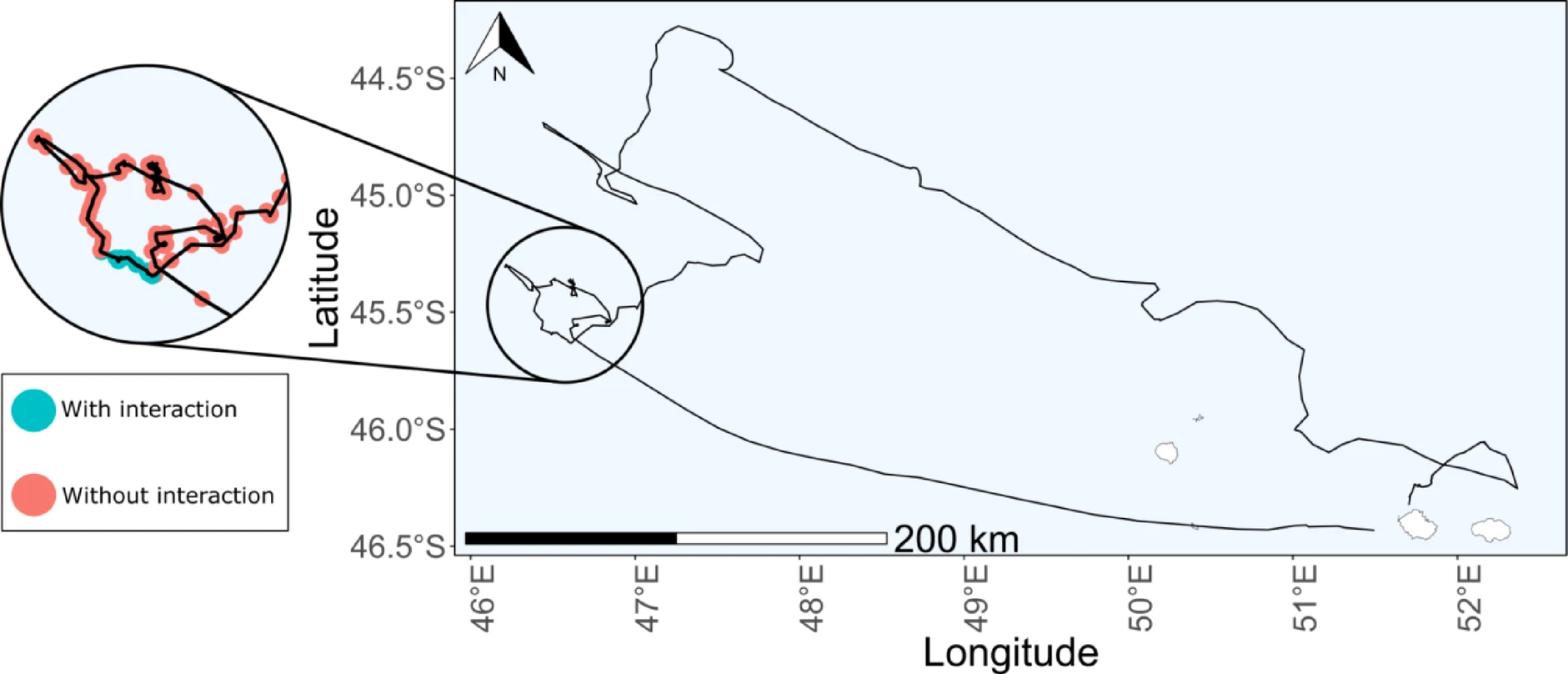 Foraging track of an adult Wandering Albatross from Possession Island during incubation, overlaid with vessel-interaction locations derived from bird-borne radar measurements in the inset (from the publication)
Ewen Le Scornec (Centre d’Etudes Biologiques de Chizé, La Rochelle Université, Villiers-en-Bois, France) and colleagues have published open access in the journal Scientific Reports on the use of radar mounted on Wandering Albatrosses Diomedea exulans to monitor toothfish and tuna longliners in the Southern Ocean.
The paper’s abstract follows:
“Fisheries have major ecological impacts including bycatch of foraging seabirds, but it is often difficult to obtain comprehensive information on the presence of fishing vessels. Automatic Identification System (AIS) data can be used to monitor fisheries and their interactions with GPS-tracked seabirds, but not all vessels have their AIS operational. Bird-tied radar detectors can overcome this limit and complement monitoring, but the technology is recent and costly. We used both methods combined as a training dataset for classification algorithms, to extend the identification of interactions to GPS tracks without radar detectors nor AIS. We studied over 3 years wandering albatrosses from the French Southern Territories, interacting with toothfish and tuna longliners. We used 196 GPS tracks combined with radar detectors, to calculate different movement variables over various scales (time spent in an area, sinuosity, speed) and used a Random Forest to distinguish behaviour in presence or absence of fishing vessels. Our model reached high classification accuracy (ca. 85%) for individual birds included in the training dataset. However, we lost predictive power (around 72% of accuracy, with a drop of specificity from 76 to 59%) when predicting on individuals not included in the training dataset. Our results emphasize the importance of documenting and accounting for individual variations to use animals as sentinels. We discuss the pros and cons of different research avenues (data sampling, classification model, bird species, etc.) to eventually get to predict fisheries from bird movements only.”
Reference:
Le Scornec, E., Chimienti, M., Corbeau, A., Pajot, A., Weimerskirch, H. & Collet, J. 2025. Predicting fisheries from albatross movements requires accounting for individual variability in interaction. Scientific Reports 15, 32807.
John Cooper, Emeritus Information Officer, Agreement on the Conservation of Albatrosses and Petrels, 14 October 2026