
 English
  Français
  Español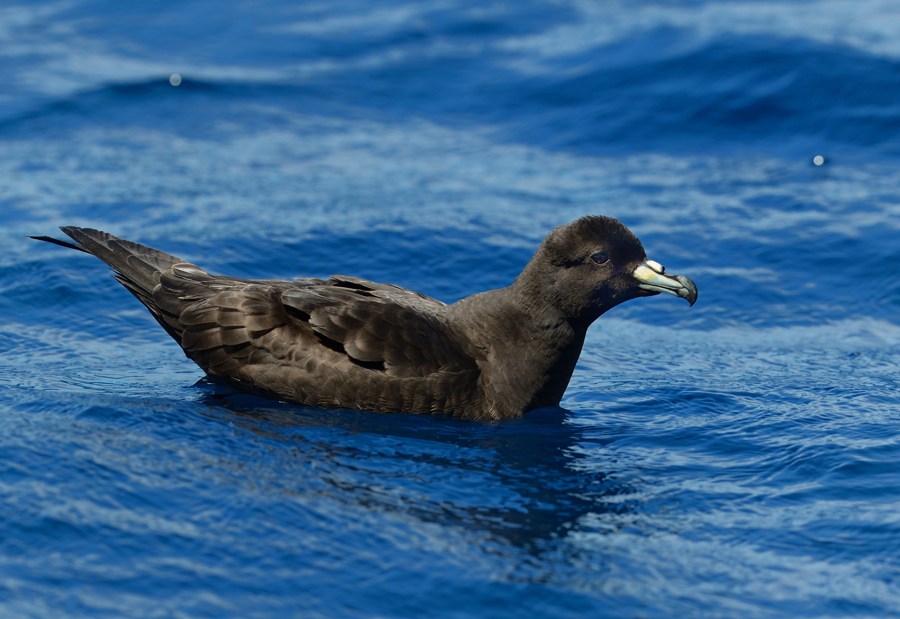
A Black Petrel off North Cape, New Zealand, photograph by Kirk Zufelt
Nicholas Daudt (Department of Marine Science, University of Otago, Dunedin, Aotearoa, New Zealand) and colleagues have published open access in the Journal of Marine Systems giving the first quantitative data on seabird assemblages off northeast Aotearoa/New Zealand. Total seabird biomass was strongly influenced by the seasonal occurrence of four medium-sized migratory procellariiforms, including the ACAP-listed and globally Vulnerable Black Petrel Procellaria parkinsoni.
The paper’s abstract follows:
“Migratory species may influence structural components of species assemblages, such as biomass and diversity patterns. A total of 10 ship-based, strip-transect seabird surveys were undertaken in all seasons (2019–2024) off the northeast coast of Northland, Aotearoa/New Zealand. Almost all seabird species recorded were migratory or wide-ranging dispersive (23 of 25). Multivariate model-based ordinations revealed that season primarily explained species assemblages, while including environmental variables such as sea surface temperature and chlorophyll-a (useful proxies for studying seabird distribution) offered little extra explanatory power at the assemblage level. There was no clear spatial pattern in the assemblages, suggesting that the study area was used uniformly by the species present at the time. The total seabird biomass present was strongly influenced by the seasonal occurrence of four medium-sized, migratory procellariiforms: tāiko (black petrel; Procellaria parkinsoni), rako (Buller’s shearwater; Ardenna bulleri), ōi (grey-faced petrel; Pterodroma gouldi) and toanui (flesh-footed shearwater; Ardenna carneipes). The biomass estimates showed an eight-fold increase from winter (243 kg/km) to summer (1885 kg/km). Northland will likely be the first region in Aotearoa/New Zealand to experience the consequences of oceanic warming. The study establishes a baseline against which to measure potential future changes in seabird occurrences. Based on descriptive and modelling approaches, the study demonstrated the role of species’ phenologies in shaping assemblages of seabird species and their impact on total estimated biomass, which may affect ecosystem functioning and energy fluxes.”
With thanks to the Pacific Seabird Group.
Reference:
Daud, N.W., Guerra, M., Brough, T., Dwyer, S.L., Zaeschmar, J.R., Schofield, M.R., Smith, R.O., Bugoni, L., Woehler. E.J. & Rayment, W.J. 2026. Migratory species strongly affect seabird biomass in seasonal assemblages off northeast Aotearoa/New Zealand. Journal of Marine Systems 255. doi.org/10.1016/j.jmarsys.2026.104201.
John Cooper, Emeritus Information Officer, Agreement on the Conservation of Albatrosses and Petrels, 16 March 2026