
 English
  Français
  Español
 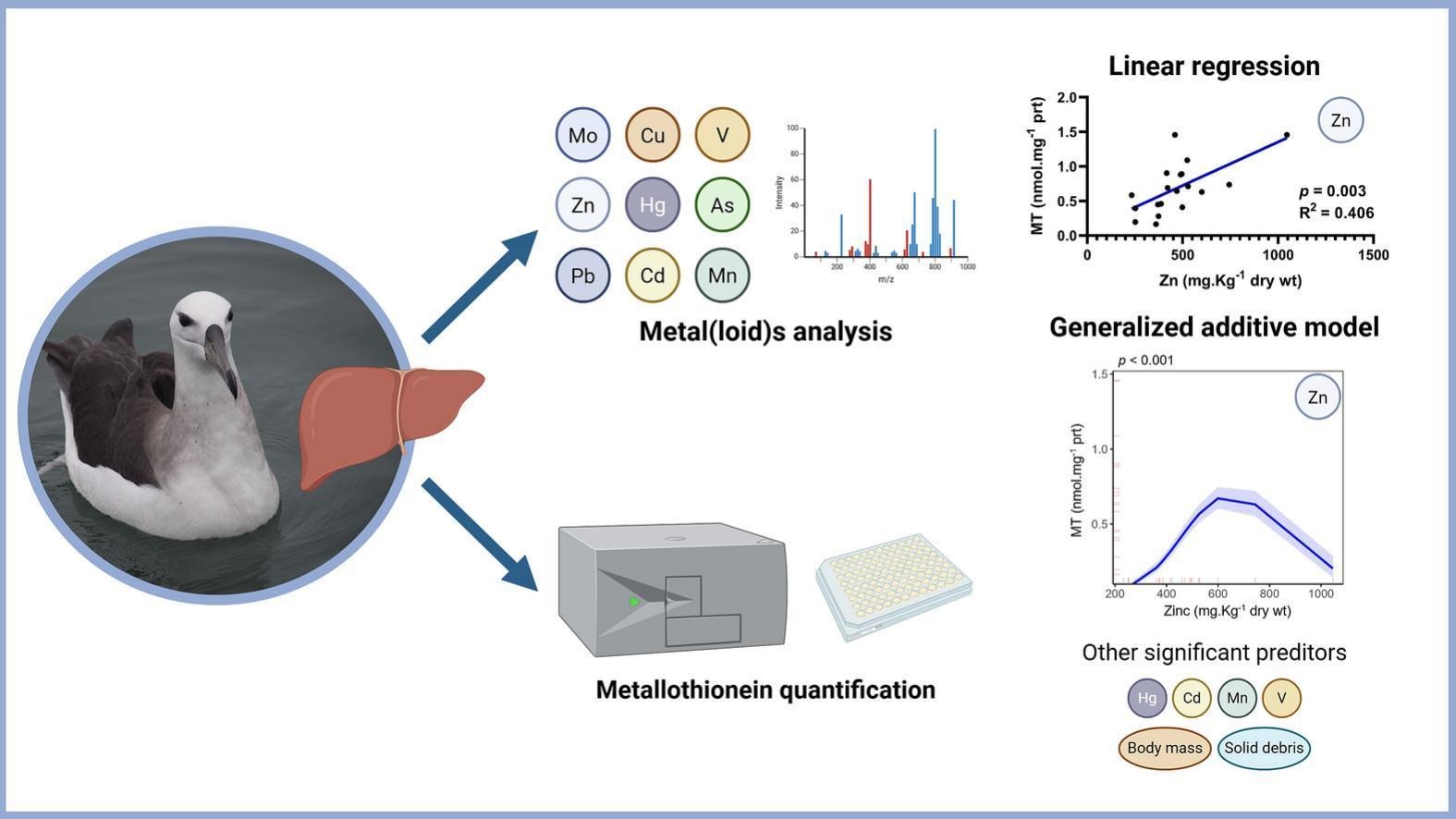 Graphical abstract, from the publication
Guilherme de Espindola da Silveira (Laboratory of Biomarkers of Aquatic Contamination and Immunochemistry, Federal University of Santa Catarina, Florianópolis, Brazil) and colleagues have published in the Marine Pollution Bulletin on metal(loid) concentrations in carcasses of stranded Black-browed Albatrosses Thalassarche melanophris from the southern and southeastern coasts of Brazil,
 A Black-browed Albatross on Islote Albatros, Tierra del Fuego, Chile, photograph by Patricia Serafini
The paper’s abstract follows:
“Metal(loid)s occur naturally in the environment; however, anthropogenic activities can release significant amounts into ecosystems, offering risks to biological communities. In response to such exposure, organisms induce the synthesis of metallothioneins (MT), low molecular weight proteins involved in metal detoxification in a wide range of organisms. In this study, we investigated the relationship between hepatic MT levels and concentrations of arsenic, cadmium (Cd), copper, mercury (Hg), manganese (Mn), molybdenum, lead, vanadium (V), and zinc (Zn), alongside biological variables, in black-browed albatrosses (Thalassarche melanophris) found stranded in southeastern Brazilian coast. Only Zn presented a positive relationship with hepatic MT levels through both correlation and linear regression analyses. Additionally, Zn was identified via generalized additive models (GAM) as the best predictor of MT variability, supporting the use of MT as biomarkers for Zn exposition in black-browed albatrosses. Other significant predictors of MT levels included hepatic concentrations of Cd, Hg, Mn, and V, as well as body mass, sex, and presence of solid debris in the gastrointestinal tract. GAM indicated complex non-linear relationships between MT levels and Cd, Hg and Zn concentrations. An initial positive association was observed between MT and Zn, reversing once Zn exceed ∼600 mg·kg−1 dw. The opposite was detected for Cd and Hg: initially, as concentration of both metals increases, MT levels tend to decrease, but rise again after reaching an inflexion point. These results suggest that multiple detoxification pathways may act in concert with MT, underscoring the need for integrative approaches to assess metal(loid)s stress in seabirds.”
Reference:
de Espindola da Silveira, G., dos Santos Lima, G., Pacheco Harrison Righetto, B., Lisarb Velasquez Bastolla, ., Mattos, J.J., Menegário, A.A., Celso Dias Bainy, A., Hahn Lüchmann, K., Serafini, P.P. 2026. Relationships between metal(loid)s, biological variables and hepatic metallothionein levels in black-browed albatrosses (Thalassarche melanophris). Marine Pollution Bulletin 226, 119378.
With thanks to Patricia Serafini.
John Cooper, Emeritus Information Officer, Agreement on the Conservation of Albatrosses and Petrels, 19 February 2026