
 English
  Français
  Español
 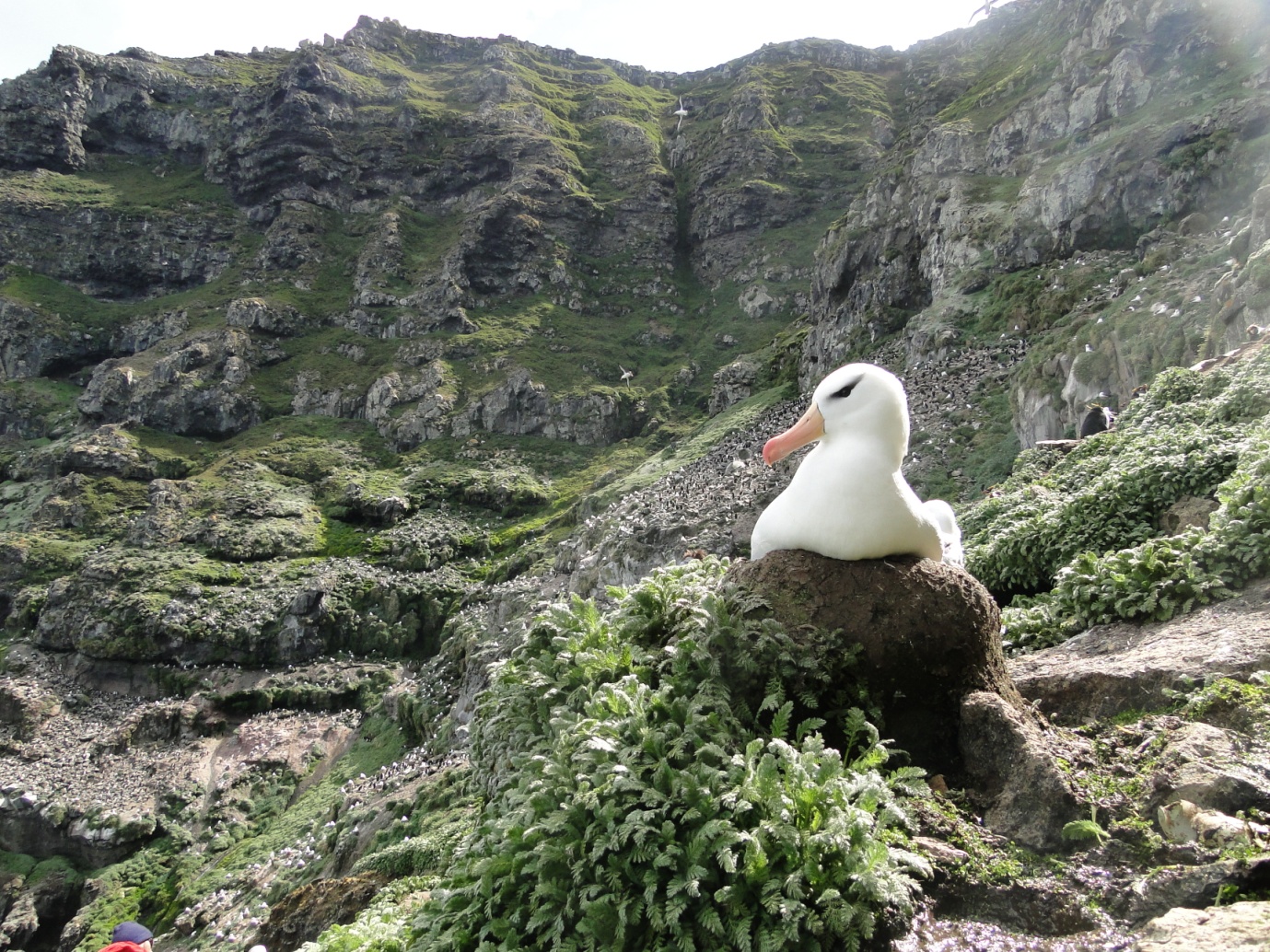 A breeding Black-browed Albatross on Kerguelen Island, photograph by Deborah Pardo
Bertille Mohring (School of Environmental Sciences, University of Liverpool, UK) and colleagues have published open access in the journal Ecology Letters on differing life-history strategies of Black-browed Albatrosses Thalassarche melanophris on Bird Island in the South Atlantic and Kerguelen Island in the southern Indian Ocean.
The paper’s abstract follows:
“Individuals face a trade-off between allocating resources to reproduction or self-maintenance, yet the drivers of the existence and strength of such trade-off have been hard to determine. Environmental conditions are thought to play a crucial role, as long-lived species are predicted to favour more precautionary life-history strategies in variable environments. However, empirical evidence remains limited. Using long-term monitoring of two black-browed albatross Thalassarche melanophris populations, we investigated variation in life-history strategies under contrasting environmental conditions, through reproductive senescence. In more variable environments, individuals displayed generally slower life histories (i.e., slow, late-onset senescence) and greater among-individual variation in life-history strategies. Interestingly, earlier and faster reproductive senescence correlated with higher lifetime reproductive success regardless of environmental variability, suggesting that either faster life histories incur higher fitness or successful reproduction accelerates reproductive senescence. These findings reveal how environmental variability shapes life-history strategies, highlighting potential responses to increasing environmental variability in a changing world.”
With thanks to Karine Delord and Richard Phillips.
Reference:
Mohring, B., Potts, J.R., Wilson, A.J., Réale, D., Phillips, R.A., Weimerskirch, H., Barbraud, C., Bennison, D., Delord, K., Wood, A.G., Peroteau, S., Rouby, E., Ventura, F. & Patrick, S.C. 2026. Environmental variability shapes life-history trade-offs within and between populations of a long-lived seabird. Ecology Letters 29(4). doi.org/10.1111/ele.70384.
John Cooper, Emeritus Information Officer, Agreement on the Conservation of Albatrosses and Petrels, 24 April 2026