
 English
  Français
  Español
 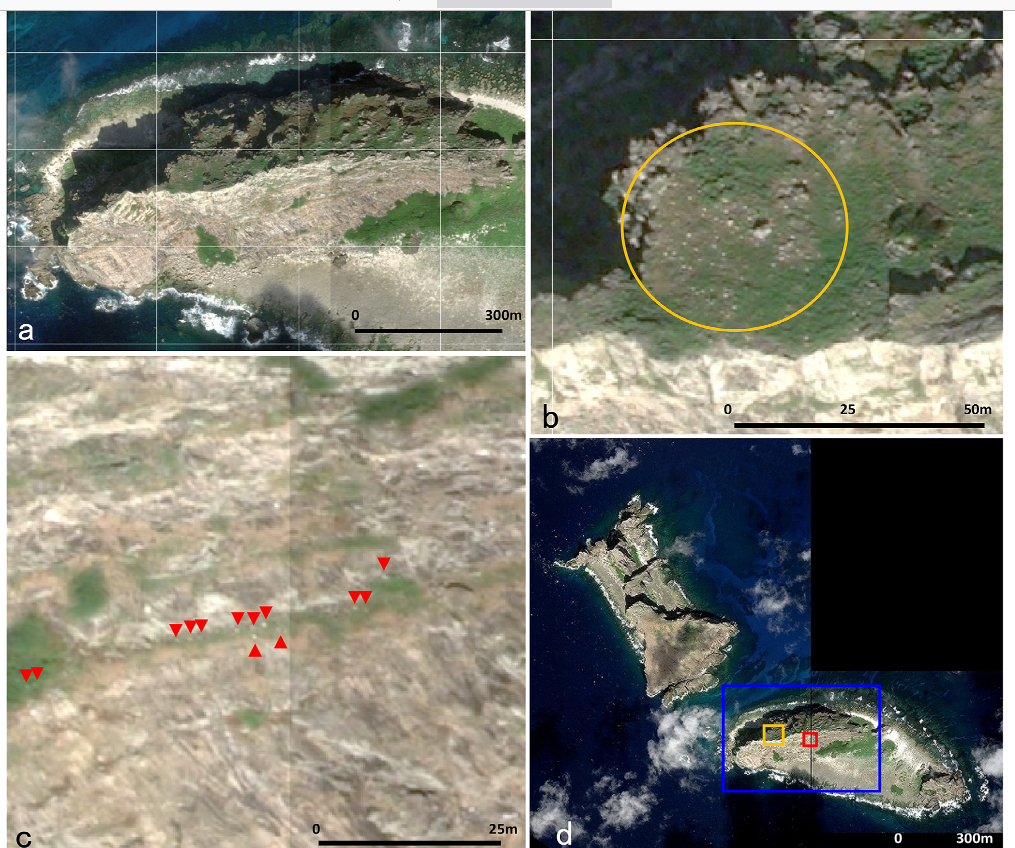 (a) Satellite image of Minami-koshima Island of the Senkaku Islands taken on 28 November 2022. (b) Colony on the slope near the cliff of Minami-koshima Island (white dots within the yellow circle: short-tailed albatrosses). (c) Colony on the narrow platform on the cliff at the southern edge of Minami-koshima Island (red triangles point to short-tailed albatross).(d) Coloured rectangles indicate enlarged areas shown in (a) (blue), (b) (orange), and (c) (red), from the publication
Jiro Otsubo (Institute of Environmental Informatics, IDEA Consultant Inc., Yokohama, Japan) and Hiroyoshi Higuchi have published in the open-access journal Endangered Species Research on the population of the Vulnerable Short-tailed Albatross Phoebastria albatrus on the disputed Senkaku/Tiaoyutai/Diaoyu Islands.
The paper’s abstract follows:
The short-tailed albatross is an endangered seabird widely distributed in the North Pacific, mainly north of 30°N. breeds only on Torishima Island, the Senkaku Islands, and the Ogasawara Islands in southern Japan in the north-western Pacific. It has been regarded as a single species, but recent studies have shown that the populations of short-tailed albatross on Torishima Island and the Senkaku Islands are morphologically and genetically different; thus, they should be classified as 2 cryptic species. Conservation plans for short-tailed albatross should therefore be developed using baseline information of each population, separately. Most of the information reported to date has come from the Torishima population, whereas little is known about the Senkaku population. Population size is a key baseline variable to consider when planning appropriate conservation strategies. Here, we counted the number of short-tailed albatrosses on the Senkaku Islands using satellite images taken on 27 November 2020 and on 28 November 2022, during the 2020-2021 and 2022-2023 breeding seasons, respectively. We estimated a total of 146 and 156 breeding pairs in November 2020 and 2022, respectively. We highlight the importance of monitoring short-tailed albatrosses on the Senkaku Islands, the reliability of information obtained using satellite images compared to the results of earlier studies, and the challenges or limitations of using satellite images of remote islands, where frequent fieldwork is difficult.”
Reference:
Otsubo, J. & Higuchi, H. 2026. Estimation of short-tailed albatross Phoebastria albatrus population on the Senkaku Islands using satellite images. Endangered Species Research 593. doi.org/10.3354/esr01462
See also:
Brothers, N., Bone, C. & Wellbelove, A. 2021. Albatross population monitoring using satellite imagery, a case study: Short-tailed Albatross Phoebastria albatrus at the Senkaku Islands. Marine Ornithology 50: 7-12.
John Cooper, Emeritus Information Officer, Agreement on the Conservation of Albatrosses and Petrels, 04 February 2026