 English
  Français
  Español
 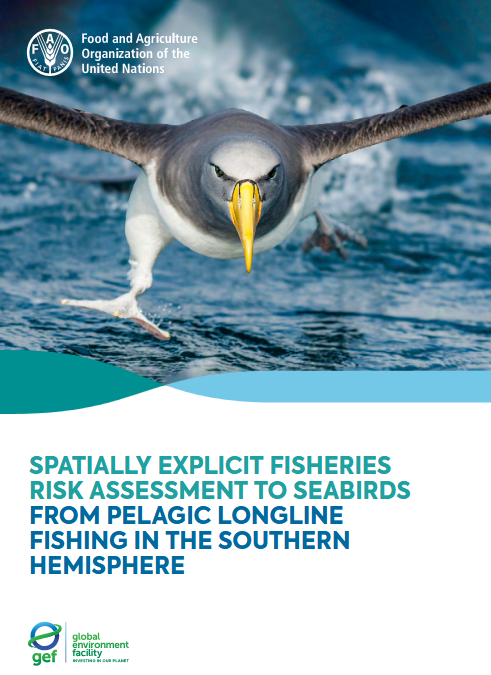 Chatham Albatross photograph by Ross Wheeler
A new major collaborative assessment of seabird interactions with pelagic longline fisheries helps address longstanding information gaps and provides fisheries managers and their fleets fresh impetus to help reduce seabird bycatch in the Southern Hemisphere.
The assessment, undertaken by the Commission for the Conservation of Southern Bluefin Tuna (CCSBT) with support from the FAO Common Oceans Program’s Tuna Project, brought together fisheries and seabird data from multiple countries and partners across the Southern Hemisphere.
Analysing 10 billion hooks of fishing effort and nearly 10 000 observed seabird captures, the assessment estimates that at least 30 000 seabirds are caught annually as bycatch in the pelagic longline fisheries assessed. The study also estimates the relative impact of this bycatch by considering both the species’ vulnerability to capture and the size of their populations. Hotspots of seabird bycatch risk were identified in parts of the Tasman Sea, southern Indian Ocean and southeast Atlantic.
“This has been a major collaborative effort, showing the value of bringing together fisheries data, seabird science and management expertise to support more targeted and effective conservation action. The findings give managers a stronger evidence base to focus mitigation and monitoring efforts to reduce seabird mortality”, said Manuel Barange, Assistant Director-General and Director of FAO’s Fisheries and Aquaculture Division. “The results will further support ongoing efforts by Regional Fisheries Management Organizations, governments, industry and other partners to reduce seabird bycatch.”
Jonathon Barrington, executive secretary of the Agreement on the Conservation of Albatrosses and Petrels (ACAP), said that fisheries bycatch remains a significant threat to certain species of albatross and petrel.
“The scale of the bycatch of birds is still significant, threatening the survivability of some species. Albatrosses and petrels are the most threatened seabird species in the world, with some species Critically Endangered,” Barrington said.
Dominic Vallieres, executive secretary of the Commission for the Conservation of Southern Bluefin Tuna, welcomed the seabird assessment. “CCSBT Members have made a considerable investment in this work with the aim of supporting management outcomes that give greater consideration to the wider ecosystem,” he said.
The CCSBT assessment applied a Spatially Explicit Fisheries Risk Assessment (SEFRA) to quantify seabird bycatch risk associated with pelagic longline fisheries operating south of the equator from 2012 to 2023, integrating observer data from six CCSBT members and Brazil with spatio-temporal seabird density surfaces.
The assessment identified particularly high impacts on a number of albatross species, including Gibson's[Antipodean], Amsterdam, Tristan, Atlantic Yellow-nosed and Sooty Albatrosses”.
[Above text extracted from the FAO media release].
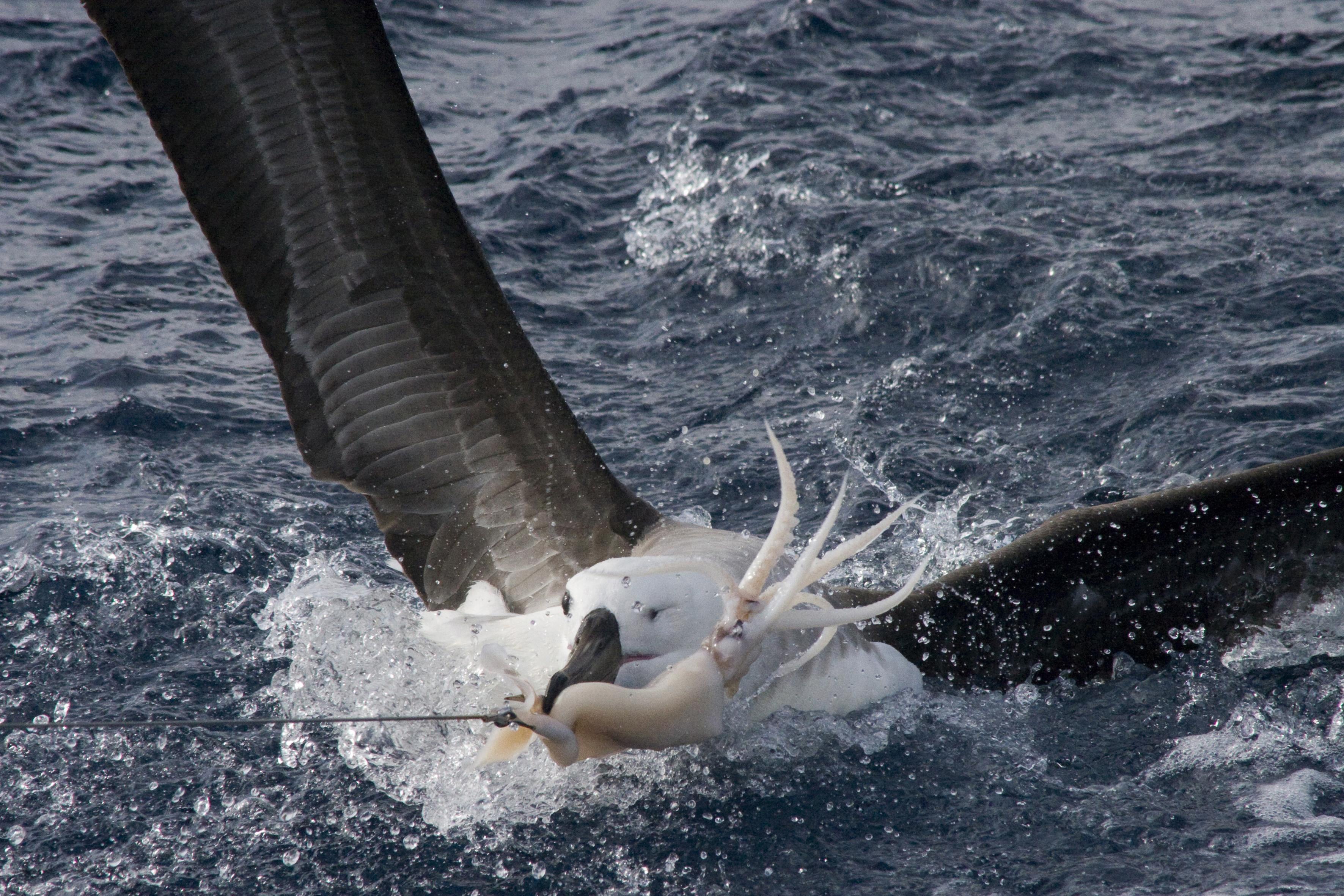 A juvenile Black-browed Albatross gets caught on a baited longline hook baited with a squid off the coast of Brazil. The bird was later released, photograph by Fabiano Peppes
The reports short abstract follows:
“This report presents a spatially explicit assessment of the risk posed to seabirds by pelagic longline fisheries operating across the southern hemisphere from 2012 to 2023. It combines observer data from seven national fleets with detailed information on seabird distribution and population dynamics. The analysis covers approximately ten billion hooks of fishing effort and documents close to ten thousand observed seabird captures. Using a modelling framework that links fishing effort, seabird density and estimated catchability, the study provides an annual mortality estimate of about thirty thousand seabirds, including mortality that is not directly observed. The assessment shows that risk is unevenly distributed among species groups. Great albatrosses and several mollymawk species experience the highest relative impacts, while petrels account for the largest absolute numbers due to their wider distribution and larger populations. Spatial analyses identify persistent bycatch hotspots in the Tasman Sea, the southern Indian Ocean and the southeast Atlantic. Mortality is concentrated in three major ocean management areas, with the Atlantic accounting for the largest share. The report highlights uncertainties related to incomplete observer coverage, unreported fishing activity and behavioural changes associated with observer presence. It concludes that seabird bycatch in southern hemisphere pelagic longline fisheries remains widespread, spatially concentrated and likely underestimated, underscoring the need for improved monitoring and mitigation.”
Reference:
FAO. 2026. Spatially explicit fisheries risk assessment to seabirds from pelagic longline fishing in the southern hemisphere. Rome: Food and Agriculture Organization of the United Nations. 51 pp.
John Cooper, Emeritus Information Officer, Agreement on the Conservation of Albatrosses and Petrels, 08 October 2026