
 English
  Français
  Español
 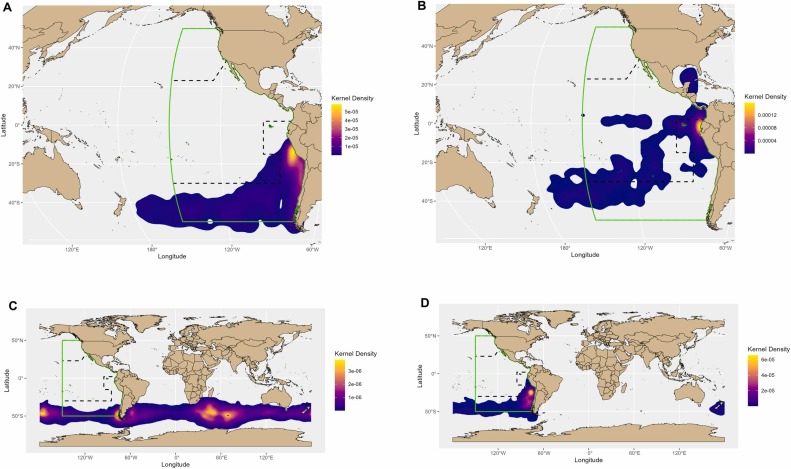 Four representative global utilization distributions (UDs) for (A) non-breeding adult Chatham Albatrosses (B) non-breeding adult Black Petrels, (C) non-breeding adult Wandering Albatrosses and (D) non-breeding adult Salvin’s Albatrosses. The green line outlines the IATTC Convention Area, while the areas north of the northern black dashed line and south of the southern black dashed line represent where two mitigation methods are required by the IATTC. From the publication
Daniel Crear (Inter-American Tropical Tuna Commission, La Jolla, California, USA) and colleagues have published open access in the journal Fisheries Research on albatross and petrel overlap with Inter-American Tropical Tuna Commission (IATTC) pelagic longline fisheries in the eastern Pacific as determined by tracking.
The paper’s abstract follows:
“Bycatch in fisheries is a major threat to seabird populations worldwide, including in the eastern Pacific Ocean (EPO). Pelagic longline fisheries targeting tuna and swordfish globally account for tens of thousands of seabird mortalities annually. However, regional overlap patterns remain poorly quantified. To quantify spatial overlap with industrial and small-scale coastal longline fisheries in the EPO, we collated tracking data from 1993 to 2022 for albatrosses (12 species) and petrels (4 species) of high conservation concern. Utilization distributions (UDs) were calculated for each species split into breeding and non-breeding phases and according to age class and tag type, and overlaid with three pelagic longline effort datasets: industrial fisheries logbook data, Global Fishing Watch set-level data, and data on small-scale coastal fisheries. We also examined overlap of species UDs with the area where seabird bycatch mitigation is mandated by the Inter-American Tropical Tuna Commission (IATTC). Species with the highest fisheries-overlap, a proxy for exposure risk, included non-breeding adult black (Procellaria parkinsoni) and white-chinned petrels (P. aequinoctialis), Chatham (Thalassarche eremita), Buller’s (T. bulleri), Antipodean (Diomedea antipodensis antipodensis), and Salvin’s (T. salvini) albatrosses, and breeding waved albatrosses (Phoebastria irrorata). The IATTC mitigation area appeared to encompass most core habitat in the EPO for seabird species considered, with the notable exception being more tropically foraging black petrels, which largely occurred outside this area. Within this area, it is critical that mitigation measures follow the best available science, are updated as new science becomes available, and observer coverage is sufficient to monitor seabird bycatch rates and evaluate compliance.”
With thanks to Richard Phillips.
Reference:
Crear, D.P., Clay, T.A., Carneiro, A.P.B., Fischer, J.H., Debski, I., Anderson, D.J., Awkerman, J.A., Baylis, A.M.M., Bell, E.A., Campioni, L., Catry, P., Clavelle, T., Deppe, L., Elliott, G., Hedd, A., Landers, T.J., Montevecchi, W.A., Nicholls, D.G., Parker, G.C., Phillips, R.A., Ponchon, A., Rexer-Huber, K., Robertson, C.J.R., Rowley, O.C., Shaffer, S.A., Stanworth, A., Thompson, D.R., Walker, K. & Lopez, J. 2026. Albatross and petrel overlap with pelagic longline fisheries in the Eastern Pacific Ocean. Fisheries Research 302, 107861.
John Cooper, Emeritus Information Officer, Agreement on the Conservation of Albatrosses and Petrels, 08 September 2026