
 English
 Français
 Español
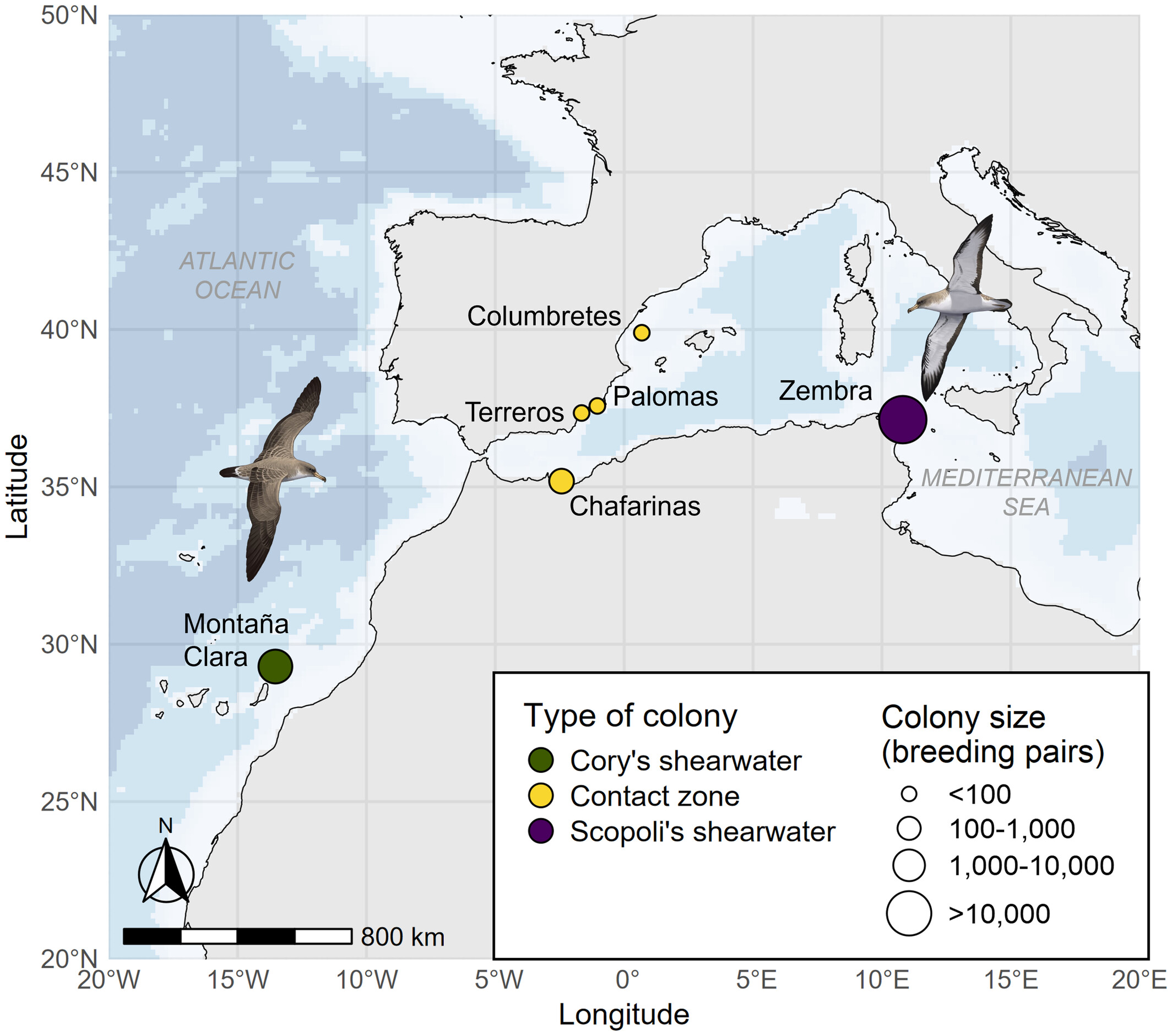 Studied allopatric and sympatric colonies of Cory's and Scopoli's Shearwaters, from the publication
Beñat Garcia-Urdangarin (Departament de Biologia Evolutiva, Universitat de Barcelona, Spain) and colleagues have published open access in the journal Molecular Ecology on migration tracks of Cory's Calonectris borealis and Scopoli's C. diomedea Shearwaters and their hybrids.
The paper’s abstract follows:
“Contact zones, where related taxa breed sympatrically, provide natural laboratories for studying phylogeography and speciation. In migratory species, these systems offer unique opportunities to disentangle the relative roles of genetic and social factors in migratory behaviour. Cory's (Calonectris borealis) and Scopoli's shearwaters (C. diomedea) are closely related long-distance migrants that breed allopatrically across most of their ranges but occur sympatrically in the Alboran Sea. Here, we tested whether the migratory strategies of these shearwaters are determined primarily by their genetic ancestry or by the social environment of their breeding colony. We used light-level geolocators to track the annual migration of 50 individuals (127 tracks) from six breeding colonies: four sympatric colonies within the Alboran contact zone and one allopatric colony of each species. We also generated whole-genome sequencing data for 58 individuals (including all 50 tracked birds) to infer species ancestry and identify hybrids. Most Cory's shearwaters wintered in subtropical Atlantic upwelling systems along the African and South American coasts, whereas most Scopoli's shearwaters wintered in tropical waters off West Africa. The two taxa partially overlapped in the Sahelian upwelling and Angolan waters. Individuals breeding in the contact zone exhibited migration strategies that matched their genomic ancestry rather than the colony's predominant pattern. Most importantly, we identified seven recent hybrids between the two taxa, representing 17.5% of the sampled individuals in the contact zone. These hybrids exhibited intermediate migratory strategies, indicating a strong genetic determination of migratory behaviour. The overlap in wintering areas may increase opportunities for interspecific interactions before arrival at the breeding colonies, potentially promoting hybridisation. Our study demonstrates that migratory strategies are strongly influenced by genetic background in long-distance migratory seabirds and suggests that weak migratory connectivity among populations facilitates hybridisation in contact zones.”
Reference:
Garcia-Urdangarin, B., Obiol, J.F., Paris, J.R. et al. 2026. When hybrids take an intermediate route: genetic ancestry shapes migration across a seabird contact zone. Molecular Ecology 35, 20: e70598.
John Cooper, Emeritus Information Officer, Agreement on the Conservation of Albatrosses and Petrels, 29 October 2026