
 English
  Français
  Español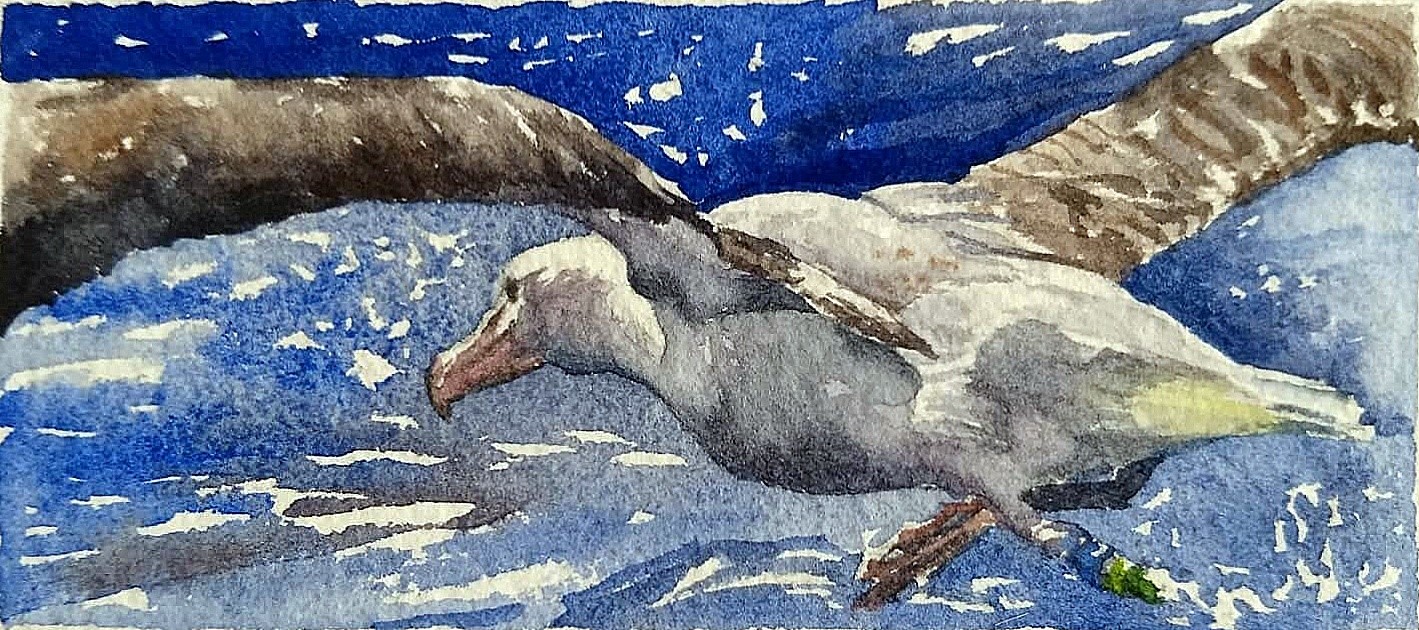
Northern Royal Albatross at sea for World Albatross Day 2020, artwork by Kitty Harvill after a photograph by Laurie Smaglick Johnson
Nicholas Daudt (Department of Marine Science, University of Otago, Dunedin, Aotearoa, New Zealand) and colleagues have published open access in the journal Estuarine, Coastal and Shelf Science on seabird assemblages off the east coast of South Island, New Zealand. Albatrosses and petrels tended to occur offshore (>35 km).
The paper’s abstract follows:
“Understanding the relationships between organisms and their environment is crucial to determining important areas for conservation and monitoring. In rapidly changing oceans, one approach to quantify these relationships is to identify species assemblages. This study used a nine year dataset of seabird observations sampled approximately every two months during a cross-shelf transect to describe assemblages at the Subtropical Frontal Zone, in southeast Aotearoa/New Zealand. During 36 voyages, 47 species and a minimum of 69,025 individual birds were recorded. We used multivariate, model-based ordinations to identify assemblages against spatial (distance from the coast), temporal (season) and environmental (water mass) predictors. The multivariate models suggest that the distance from the coast and seasons explain most of the observed variability. Gulls and shags influenced a coastal assemblage (25 km from the coast), and most albatrosses and petrels were only recorded offshore (35 km). Seasons strongly influenced the assemblages, with 31 of the 39 analysed species classified as migratory or dispersive. Over the nine year dataset, the probability of occurrence of nearly 40% of the analysed species changed, indicating possible changes in the assemblage structure and species’ ranges. This study shows the importance of accounting for seasonality when describing assemblages in regions supporting high proportions of migratory and/or wide-ranging species. The observed changes in the probability of occurrence of several species may be the first evidence for the effects of oceanographic changes recently described for the southwest Pacific Ocean due to above-average warming caused by climate change.”
With thanks to the Pacific Seabird Group.
Reference:
Daudt, N.W., Loh, G, Currie, K.I., Schofield, M.R., Smith, R.O., Woehler, E.J., Bugoni, L. & Rayment, W.J. 2025. Changing species occurrences at the Subtropical Frontal Zone. Estuarine, Coastal and Shelf Science 323, 109405. doi.org/10.1016/j.ecss.2025.109405.
John Cooper, Emeritus Information Officer, Agreement on the Conservation of Albatrosses and Petrels, 18 March 2026