 English
  Français
  Español
 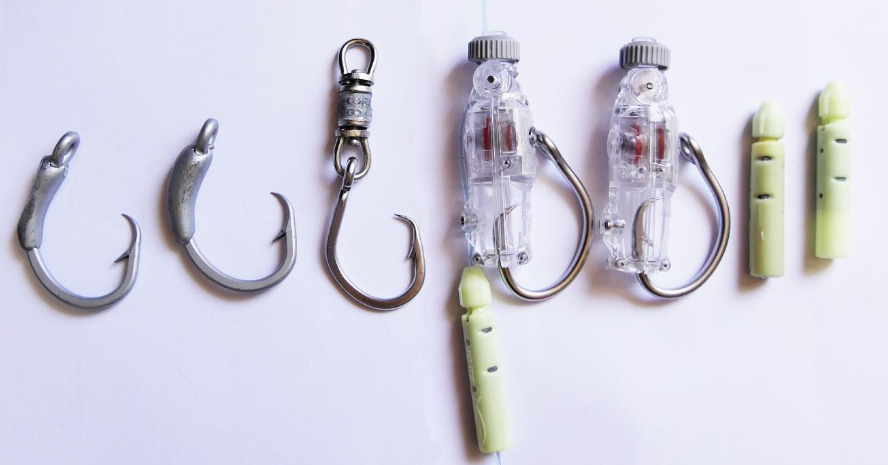 Branchline weighting options tested, from left to right: 50 g 16/0 Procella hook, 62 g 16/0 Procella hook, 14/0 weighted swivel hook (53 g total weight), Hookpod and 60 g lumo lead with 22 g 16/0 hook. Hookpod with 22 g 16/0 hook, 60 g lumo lead, 40 g lumo lead. Note lumo leads were deployed on branchlines with 22 g 16/0 circle hooks (from the publication)
D. Goad and C Schweder-Goad (Vita Maris, New Zealand) have produced a final report for the New Zealand Department of Conservation’s Conservation Services Programme (CSP) on sink rates of weighted longline hooks.
The report’s Summary follows:
“The use of line weighting to rapidly sink baited hooks under the protection of a tori line is recognised as an effective mitigation measure to reduce the bycatch of seabirds during the deployment of pelagic longlines.
Time depth recorders (TDRs) were used to compare sink profiles of heavy hooks and hook shielding devices to established best practice line weighting configurations. Tests were conducted both from a stationary vessel and during fishing operations. Sink times to depth were slower and more variable under real-world fishing conditions than under controlled conditions.
Both 60 g and 50 g heavy hooks sank with similar profiles to the current ACAP best practice line weighting recommendations of 60 g at a metre from the hook or 40 g at half a metre. The size and density of hook shielding devices reduced sink times, particularly under fishing “conditions, indicating that the bulk of devices added to branchlines should be considered.”
Reference:
Goad, D. & Schweder-Goad, C. 2025. Assessment of Weighted Hooks as a Seabird Bycatch Mitigation Option for Surface Longline Fisheries. MIT2024-03. Final Report. Vita Maris. 9 pp.
John Cooper, Emeritus Information Officer, Agreement on the Conservation of Albatrosses and Petrels, 03 April 2026