
 English
  Français
  Español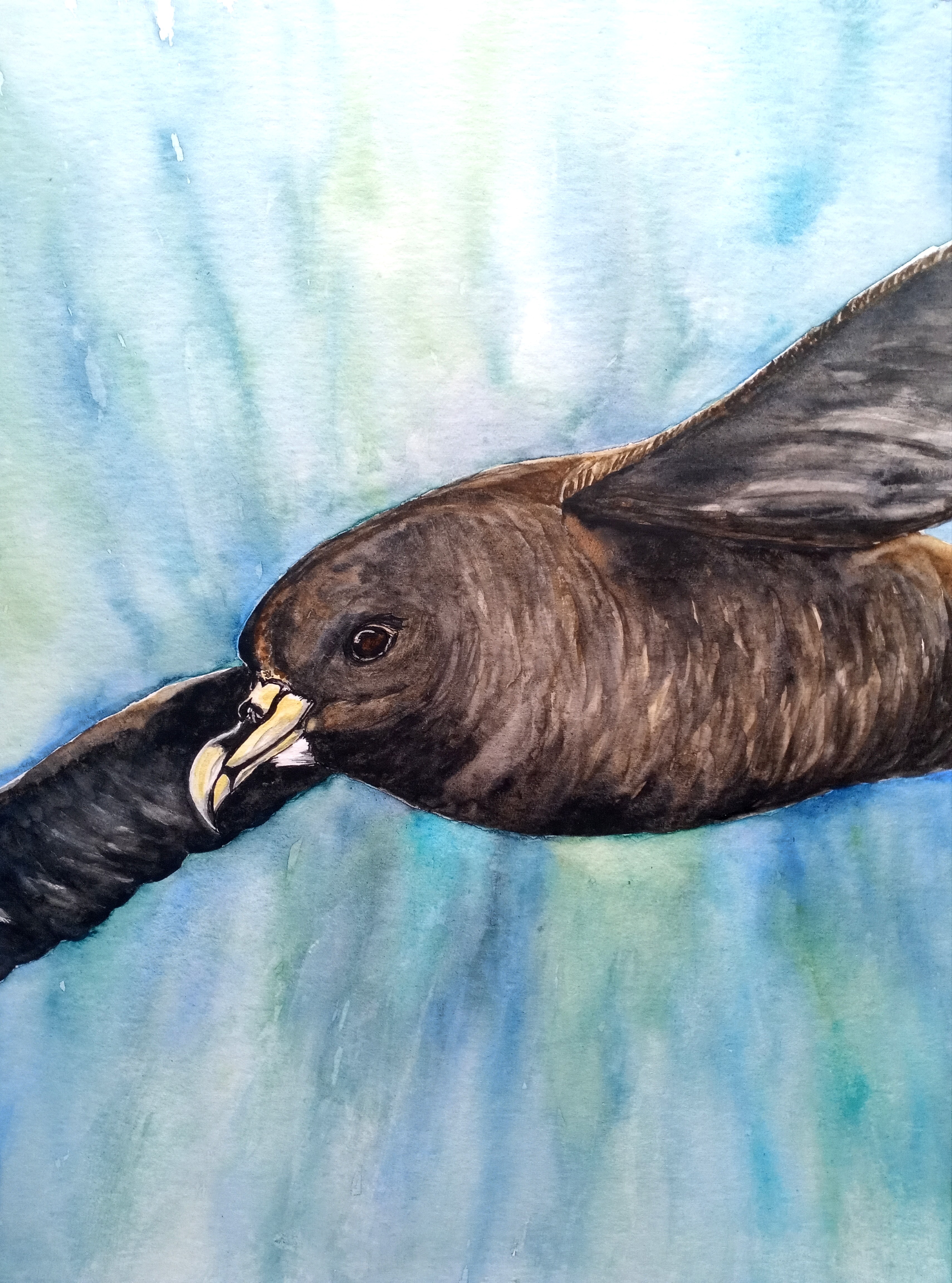
White-chinned Petrel at sea, watercolour by Helen Worthington of Artists & Biologists Unite for Nature (ABUN) for ACAP, after a photograph by Kirk Zufelt
Victoria Warwick-Evans (Ecosystems, British Antarctic Survey, Cambridge, UK) and colleagues have published in the journal Royal Society Open Science on at-sea tracking of Vulnerable White-chinned Petrels Procellaria aequinoctialis from three colonies in the South Atlantic.
The paper’s abstract follows:
“By-catch in fisheries is the leading cause of population decline in pelagic sea-birds. The white-chinned petrel (Procellaria aequinoctialis) is the most by-caught sea-bird species in the Southern Ocean, and many populations are in decline. To better understand by-catch risk, we tracked white-chinned petrels from three sites across South Georgia throughout the annual cycle. There was no spatial segregation among colonies in at-sea distributions of failed or non-breeding birds, but birds tracked during chick-rearing from the easternmost site (Cooper Island) and the centre (King Edward Point), travelled both east and west of South Georgia, whereas those tracked from the west (Bird Island) only travelled west. Consequently, white-chinned petrels from Cooper Island overlapped less with fisheries than those from the other sites. Habitat models suggest that white-chinned petrels from all sites foraged in areas with similar environmental characteristics and that suitable conditions were present both east and west of South Georgia. Thus, broad-scale areas of high by-catch risk could be identified from predicted distributions, but overlap at finer scales could be distinguished more clearly from tracking data. Although the driver of spatial segregation in foraging areas was unclear, it affects by-catch risk and has implications for conservation and management.”
With thanks to Richard Phillips, British Antarctic Survey.
Reference:
Warwick-Evans, V., Pearmain, E. & Phillips, R.A. 2026. Year-round spatial segregation and fisheries overlap of white-chinned petrels from multiple populations at South Georgia. Royal Society Open Science 13: 260099.
John Cooper, Emeritus Information Officer, Agreement on the Conservation of Albatrosses and Petrels, 01 October 2026