
 English
 Français
 Español
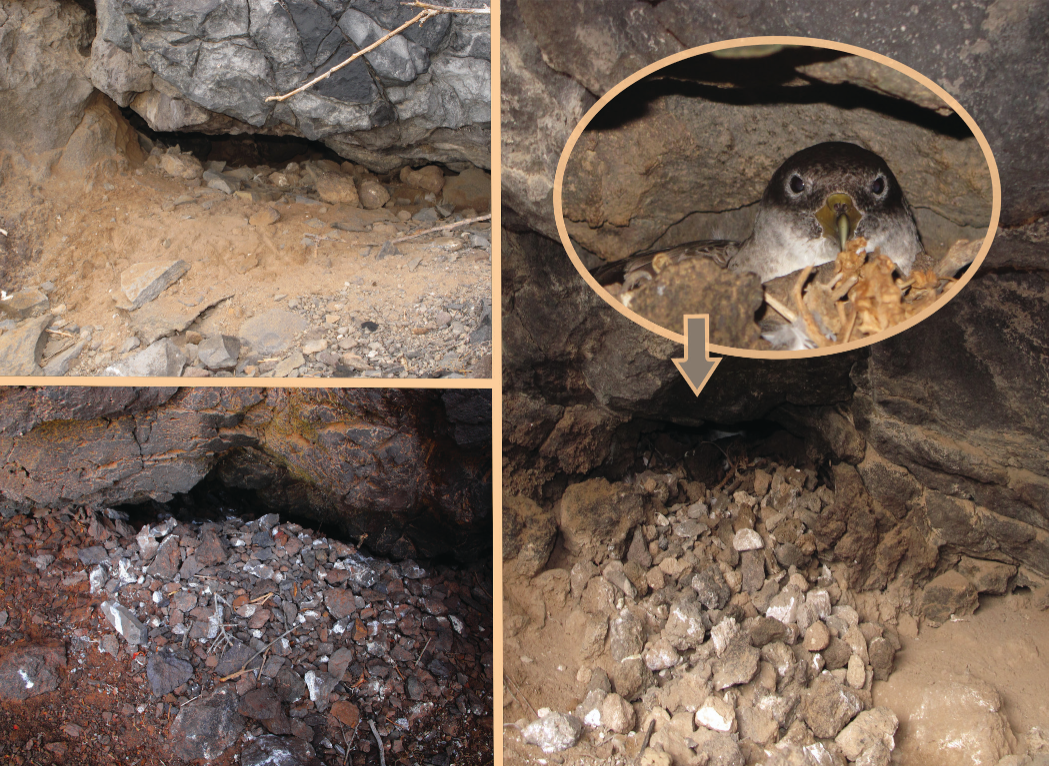 Three examples of Cory’s Shearwater Calonectris borealis nests on Tenerife, Canary Islands, Spain, showing the absence (top left) and presence of stone accumulations at the entrances (bottom left and right). The inset is of an incubating adult, from the publication
Cristina de Tena (Department of Evolutionary Ecology, Museo Nacional de Ciencias Naturales, Madrid, Spain) and colleagues have published in the open-access journal Marine Ornithology on Cory's Shearwaters Calonectris borealis placing stones at their burrow entarnces
The paper’s abstract follows:
“Nest construction is a widespread form of animal architecture with adaptive functions, including offspring protection, microclimate regulation, and parasite reduction. Nests are therefore considered extended phenotype signals that reflect the behavioural, cognitive, and energetic investment of their builders. Most petrels (Order Procellariiformes) breed in simple cavities, including burrows they excavate. One species, Cory's Shearwater Calonectris borealis, often accumulates stones at nest entrances, a behaviour rarely reported among petrels and whose function remains poorly understood. These stone accumulations are associated with increased hatching and breeding success, although the underlying mechanisms are unknown. A small, manipulative experiment revealed that adults actively relocate stones, particularly early in the breeding season. We propose that stone piles may constitute an extended phenotypic trait linked to reproductive investment, nest defence, or environmental regulation. We highlight the complexity of this behaviour and emphasize the need for further research to understand its ecological and reproductive significance.”
Reference:
De Tena, C., Rodríguez, B. & Rodríguez, A. 2026. Why do some shearwaters accumulate stones at their nest entrances? Marine Ornithology 54: 381-385.
John Cooper, Emeritus Information Officer, Agreement on the Conservation of Albatrosses and Petrels, 28 October 2026