
 English
  Français
  Español
 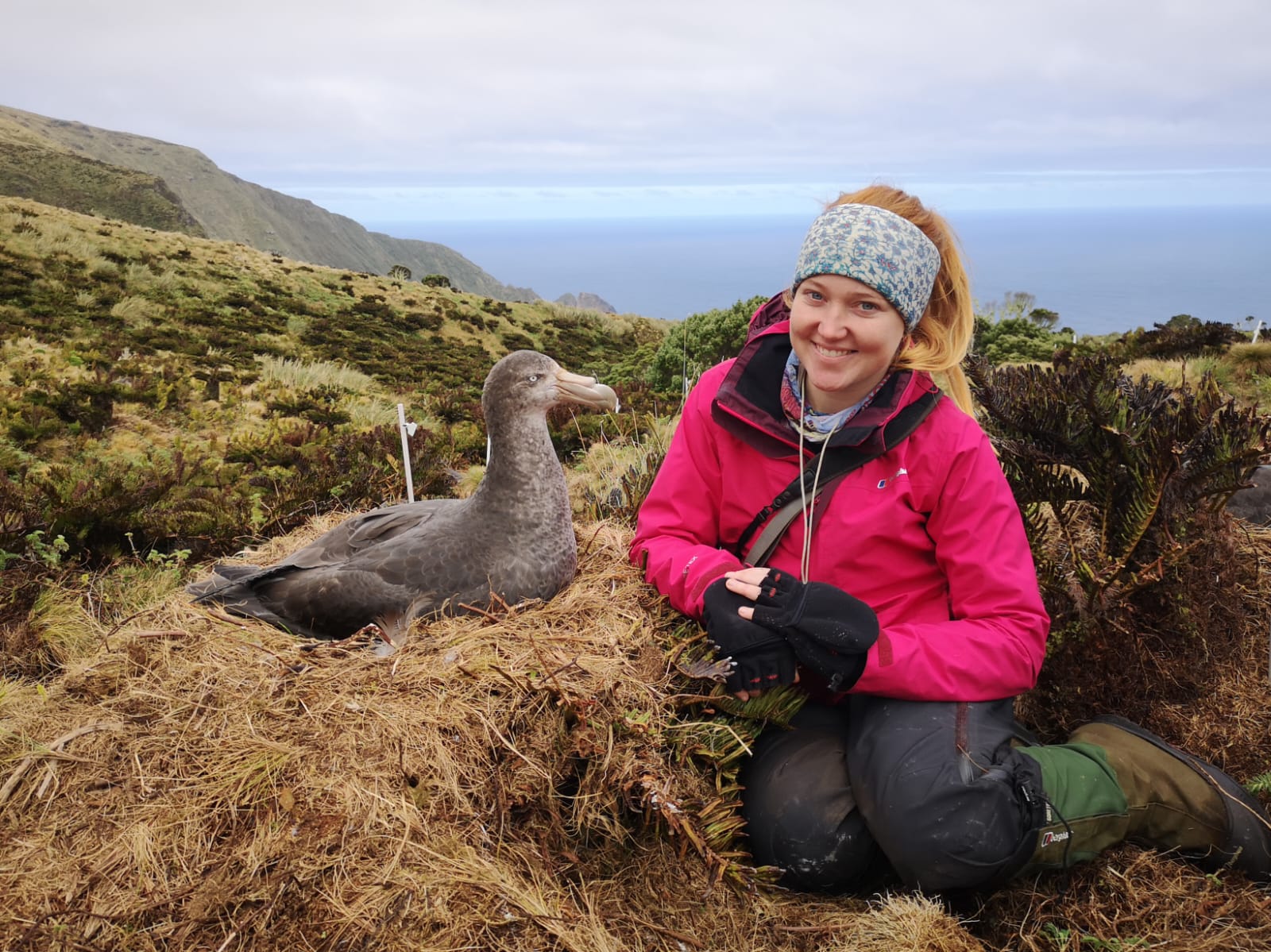 Unconcerned: Michelle Risi pauses while reading colour bands next to an incubating Southern Giant Petrel in the Low Hump colony on Gough Island, photograph by Chris Jones
I am sometimes asked “Which is your favourite among the 31 ACAP-listed seabirds?” My answer might surprise, for it is not the iconic Wandering Albatross Diomedea exulans of Marion Island or the equally iconic Tristan Albatross D. dabbenena of Gough Island, both of which I have studied. No, my co-favourites are the two giant petrels, the Northern M. halli and the Southern M. giganteus, which I have also studied on Marion (both species) and Gough (Southern) Islands. With my last island visits now over a decade ago, I am pleased that the data collected from the long-term studies of colour-banded Northerns on Marion and Southerns on Gough that I set up years back will now contribute to a PhD study by ACAP supporter, Michelle Risi – who has worked with both species in the field on Marion and Gough. She is based in the FitzPatrick Institute of African Ornithology at the University of Cape Town, where I worked for several decades last century.
Michelle Risi writes to ACAP Latest News: “I hold an MSc in Biology from the University of KwaZulu-Natal (2015), along with BSc Honours and BSc degrees, both awarded cum laude. Over the past decade, I have dedicated my career to wildlife conservation, with a particular focus on long-term seabird monitoring and the restoration of remote island ecosystems for threatened species. For the past seven years, I have worked extensively on the demographic datasets for giant petrels from Gough and Marion Islands. This has included compiling, cleaning and curating long-term monitoring data, as well as standardising records for mark-recapture and breeding success analyses. My familiarity with these datasets and the colonies they represent provides me with a unique advantage, allowing me to conduct the planned analyses efficiently and produce high-quality outputs for my PhD thesis.”
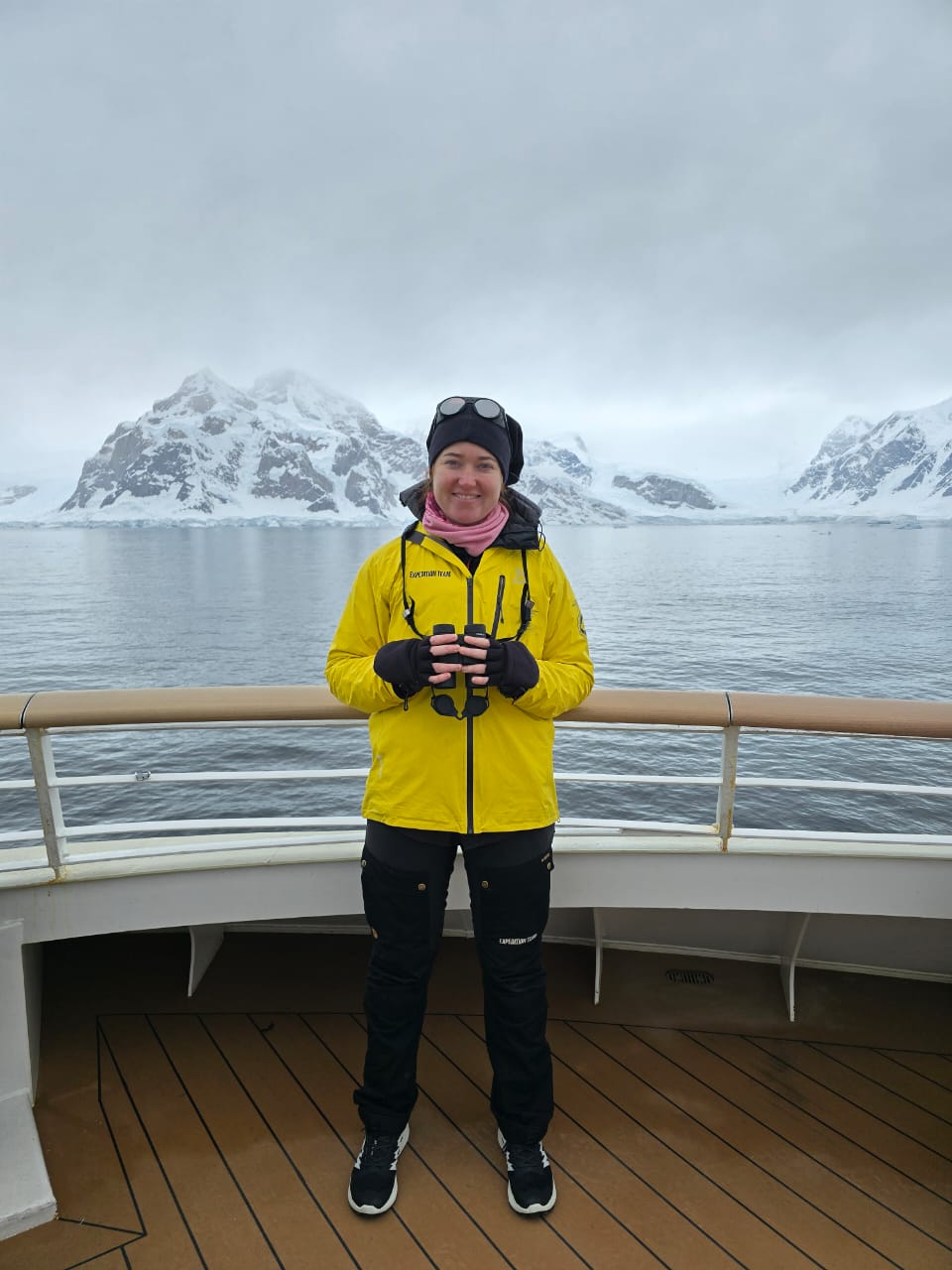 Michelle guiding aboard the Roald Amundsen along the Antarctic Peninsula in summer 2025/26
A summary of Michelle’s PhD project, entitled “Understanding the drivers of seabird demography in a changing ocean: insights from long-term studies of giant petrels”, follows:
“Global climate change and human activities are transforming marine ecosystems, yet the impacts on long-lived apex predators remain poorly understood. Seabirds, such as giant petrels Macronectes spp., are key indicators of ocean health, integrating ecological change across broad spatial and temporal scales. Northern (NGP, M. halli) and Southern Giant Petrels (SGP, M. giganteus) are large, long-lived seabirds with circumpolar distributions in the Southern Hemisphere, breeding mostly at scattered sub-Antarctic and Antarctic islands. Males play critical ecological roles as both predators and scavengers, occupying the top of the marine food web and making them especially sensitive to ecosystem changes. Females have a more pelagic distribution, ranging as far from their colonies as albatrosses, and consume a diverse diet that includes fish, crustaceans, squid and carrion. Both sexes commonly scavenge behind fishing vessels and are bycaught in various longline and trawl fisheries across the Southern Ocean. Giant petrel nestlings are impacted by heat stress, and nesting adults have also been recorded being attacked by House Mice Mus musculus on Marion Island, leading to nest abandonment.
A previous study of adult survival at Bird Island, South Georgia (Islas Georgias del Sur)*, showed that sex-specific ecological differences can lead to divergent responses to environmental drivers. For example, females were more likely to be impacted by changes in pelagic longline effort. However, that study did not assess how changing oceanographic conditions influence other critical demographic parameters, such as breeding probability and success. Even less is known about the demographic drivers of populations at other sites. As scavengers, giant petrels are at risk of secondary poisoning during rodent eradication operations, as they may forage on the carcasses of other scavenging birds. Gough Island had a failed mouse-eradication attempt in 2021, and a mouse eradication operation is planned for Marion Island in 2029 by the Mouse-Free Marion Project. On Macquarie Island, now free of invasive mammals, the aerial eradication campaign conducted between 2010 and 2011 had a substantial immediate impact on giant petrels, resulting in the deaths of up to 1400 NGPs over two years and an estimated 33% decline in breeding pairs. Rodent eradication operations are generally undertaken during winter, when most seabirds are foraging at sea, and natural food availability for mice is lowest, thereby maximising bait uptake while reducing potential impacts on non-target species. It is therefore important to establish a baseline for the number of giant petrels that remain on Marion Island during winter.
Long-term demographic datasets are available from seven Southern Ocean island groups: Signy Island in the South Orkney Islands, Bird Island at South Georgia (Islas Georgias del Sur)*, Gough Island, Marion Island in the Prince Edward Islands, Île de la Possession in the Crozet Archipelago, the Kerguelen Archipelago and Macquarie Island. These datasets include annual counts of breeding birds and fledged chicks, intensive monitoring of individual breeding attempts and, at four sites, capture-mark-recapture records that follow marked birds through their breeding histories. Together, the sites span broad geographical, oceanographic and management gradients. Marion Island will serve as the focal system for identifying environmental drivers of breeding success and other demographic parameters, after which the transferability of the results to other giant petrel colonies will be tested.
By analysing long-term demographic data from these breeding sites, the study will explore relationships between vital rates (adult and juvenile survival, breeding frequency, and breeding success) and potential oceanographic drivers (e.g. sea surface temperature, marine productivity, wind regimes). This will provide a step change in our understanding of how these key predators respond to climate variability and other anthropogenic pressures, while also identifying implications for seabird monitoring and conservation management.
Research Questions:
1. How have breeding population size and breeding success of Northern and Southern Giant Petrels at Marion Island changed over time, and what is the relative importance of local weather and breeding-season oceanographic conditions on breeding success?
2. How does winter attendance by giant petrels vary on Marion Island, and is attendance associated with previous breeding outcome and subsequent breeding probability or success?
3. How transferable are the environmental variables identified as the best predictors of giant petrel breeding success at Marion Island to other populations across the Southern Ocean?
4. How does environmental variability influence survival, recruitment and breeding probability in giant petrels?
Methods and Impact:
Using long-term breeding counts, nest-monitoring records, winter surveys, capture-mark-recapture data and remotely sensed environmental information, the study will investigate demographic variation at both colony and individual levels. Winter surveys will be used to determine which giant petrels attend Marion Island during the non-breeding period, whether winter attendance is associated with previous breeding outcome and subsequent breeding probability or success, and what proportion of breeding birds may be exposed during the planned winter mouse-eradication operation. Analyses will test whether environmental relationships identified at Marion Island are transferable to other colonies. Multi-event capture-mark-recapture analyses will then assess whether selected environmental variables explain variation in survival, recruitment and breeding probability. The study will identify the factors associated with demographic change and provide evidence to support ACAP monitoring and conservation management.”
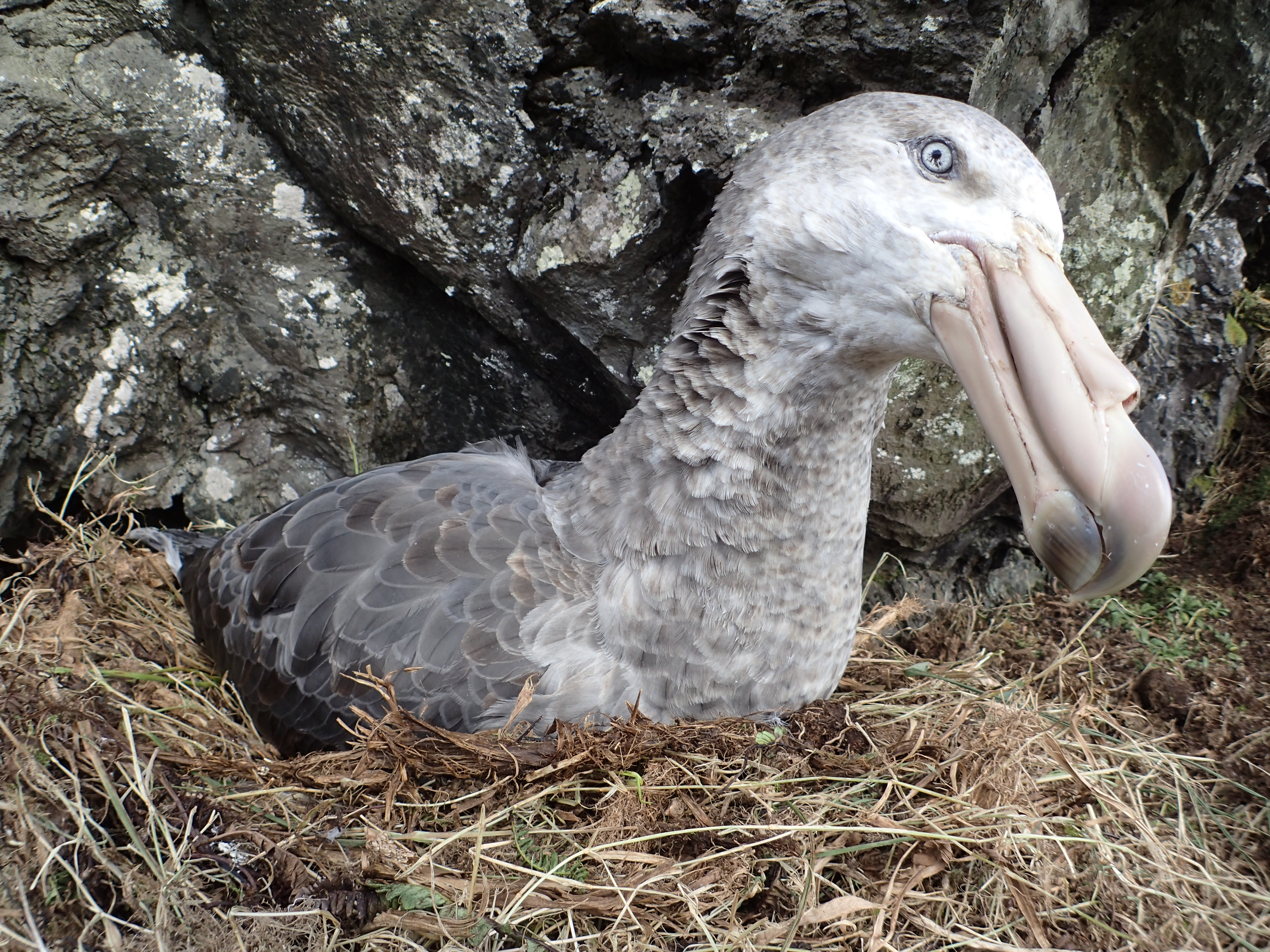 A Northern Giant Petrel on Marion Island eyes the camera, photograph by Michelle Risi
Michelle’s study will be supervised by Associate Professor Susan Cunningham (FitzPatrick Institute), Dr Steffen Oppel (Swiss Ornithological Institute), Professor Richard Phillips (British Antarctic Survey) and Emeritus Professor Peter Ryan (FitzPatrick Institute).
Back in 2019, Michelle proposed to me that there should be a World Albatross Day. Although I was initially somewhat reluctant, we submitted an Information Paper proposing the day to the ACAP Advisory Committee’s 11th Meeting, held in Brazil the same year. With the committee’s approval, ACAP marked the first World Albatross Day on 19 June 2020 under the theme of “Eradicating Island Pests”. Michelle played a significant role in supporting the first “WAD” years by producing a series of photo posters, as well as entering a cake for the “Great Albicake Bake Off” competition in 2020 (click here). Surely, now that there have been seven successful World Albatross Days held, it is past time for the two ACAP-listed giant petrels to be recognized as “honorary albatrosses” and included in the celebrations for WAD2027.
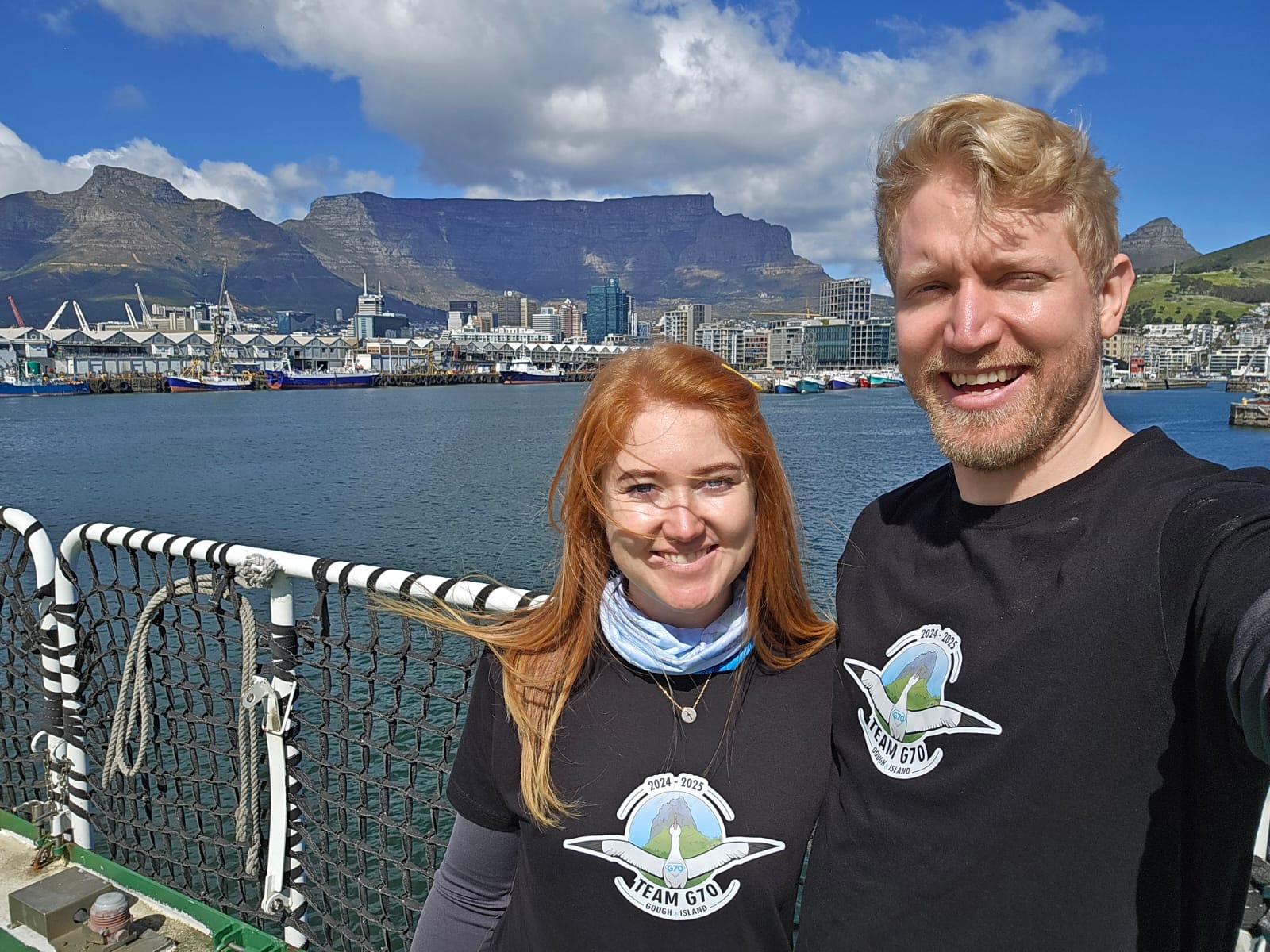 Husband and wife team, Chris Jones and Michelle Risi, sail from Cape Town for a year on Gough Island aboard the S.A. Agulhas II in September 2024
Michelle and her husband Chris Jones have recently started staying with me in my home near the university for a couple of nights every other week to make their commute from their own home a distance away to campus easier. Our dinner-table conversations often turn to Gough and Marion, their albatrosses and petrels, and stories from our respective times working with these special birds. It will then be a pleasure to hear from time to time from Michelle how her PhD work is progressing, and I look forward to reading the peer-reviewed publications that will ensue.
John Cooper, Emeritus Information Officer, Agreement on the Conservation of Albatrosses and Petrels, 21 August 2026
* A dispute exists between the Governments of Argentina and the United Kingdom of Great Britain and Northern Ireland concerning sovereignty of the Falkland Islands (Islas Malvinas), South Georgia and the South Sandwich Islands (Islas Georgias del Sur e Islas Sandwich del Sur) and the surrounding maritime areas.