
 English
 Français
 Español
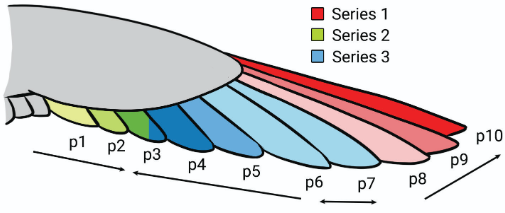 Three series of primary feather replacement in albatrosses consistent in 14 taxa, from the publication
Peter Pyle (The Institute for Bird Populations, Petaluma, California, USA) has published in the open-access journal Marine Ornithology on primary moult in juvenile albatrosses.
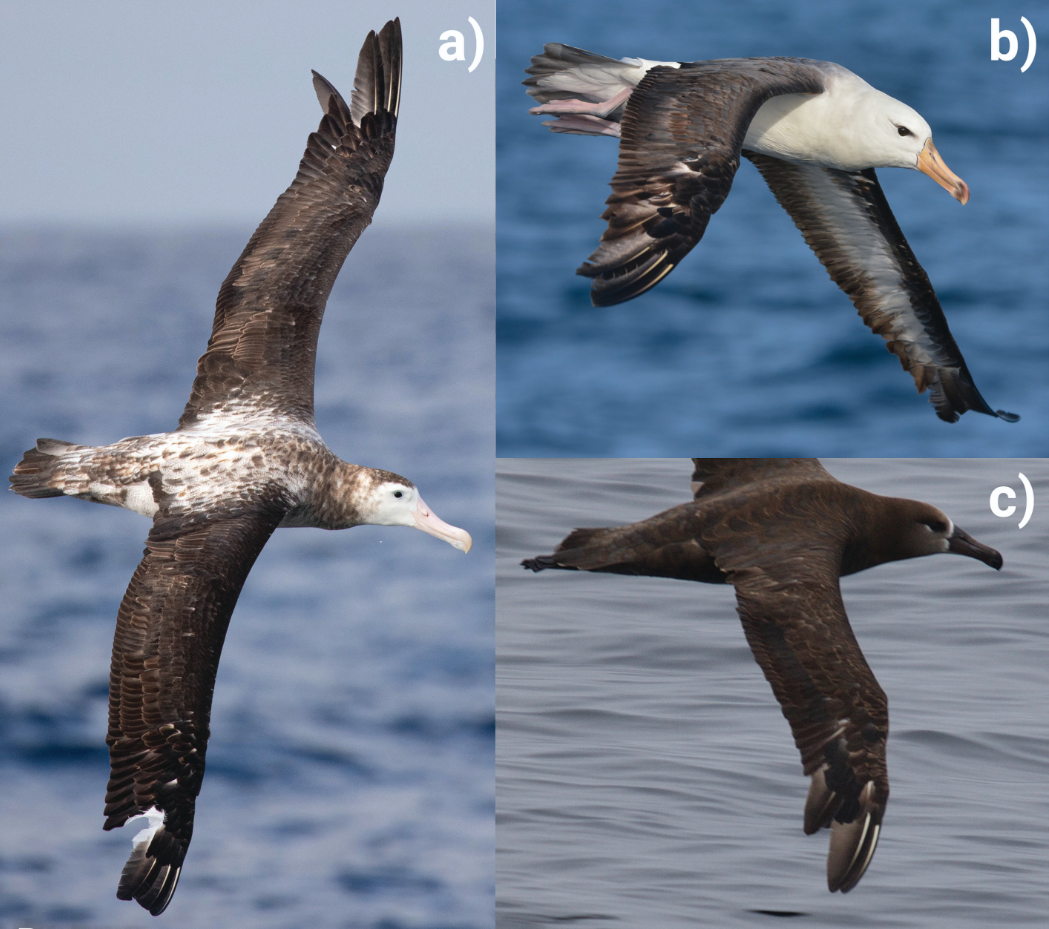 Moulting juveniles in three albatross genera: A. great Diomedea sp., B. Black-browed Thalassarche melanophris and C. Black-footed Phoebastria nigripes, from the publication
The paper’s abstract follows:
“Albatrosses have long been known to undergo complex replacement strategies among primaries, including "Staffelmauser" or stepwise molt, here expanded in definition to include replacement patterns among multiple series of primaries. Interpreting primary replacement sequences for birds undergoing Staffelmauser can be complicated by multiple molt waves, which have led to conflicting opinions on the sequences of primary replacement in albatrosses. In order to determine replacement sequences in such cases, it is necessary to examine molt of the first set of juvenile remiges, but this occurs entirely at sea in albatrosses and is thus poorly documented. Here, to clarify molt sequences, I canvassed over 63,000 images in the Cornell Lab of Ornithology's Macaulay Library and located 156 albatrosses that were molting juvenile primaries or showing mixed juvenile and basic feathers. These included 14 taxa in three genera, restricted to those in which the age of younger birds could be inferred from plumage, bill color, and/or iris color. Distal replacement of the three juvenile outer primaries (p8-p10) occurred consistently in all birds. Based on replacement of juvenile primaries, I define three molt series, p8 distally to p10, p1 distally to p3, and a series in which replacement can commence at either p7 and proceed proximally to p4 or at p6 and proceed bidirectionally to p7 and p4. In the third series, the commencement node appears to be fluid between p6 and p7, as has been proposed for nodes in other bird taxa. Other elements of albatross molt strategies besides sequence—such as timing, location, extent, and replacement rates within each molt series—appear to be less fixed. In particular, initial replacement of remiges may occur at either the first or the second prebasic molt both among and within taxa, varying in part according to primary lengths. I predict that the fixed molt series described here will occur across all taxa of Diomedeidae, but that the timing and extent of each molt will vary more widely within and among taxa, making it challenging to define precise molt cycles in albatrosses.”
Reference:
Pyle, P. 2026. Evaluation of molt sequences and strategies in albatrosses based on replacement of juvenile remiges. Marine Ornithology 54: 309-320.
John Cooper, Emeritus Information Officer, Agreement on the Conservation of Albatrosses and Petrels, 27 October 2026