 English
  Français
  Español
 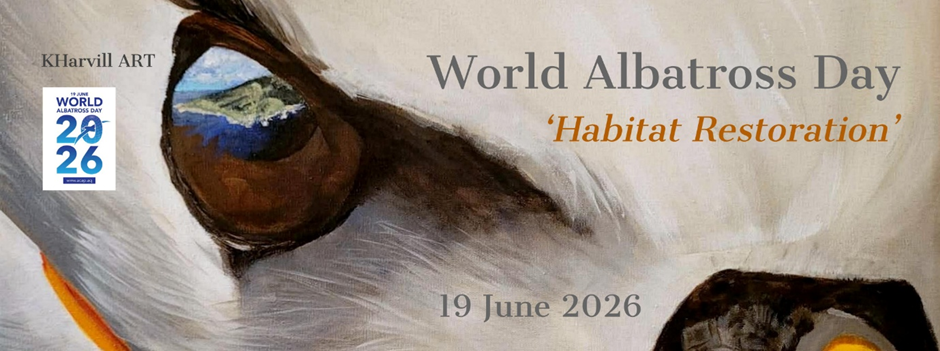 Gough Island is reflected in the eye of an Endangered Atlantic Yellow-nosed Albatross Thalassarche chlorohynchos, artwork and poster design by by Artists and Biologists Unite for Nature co-founder, Kitty Harvill, after photographs by Chris Jones and Michelle Risi
In May 2019 ACAP's Advisory Committee at its Eleventh Meeting (AC11) held in Brazil declared that a conservation crisis continues to be faced by its 31 listed species, with thousands of albatrosses, petrels and shearwaters dying every year as a result of fisheries operations. Albatrosses are among the most threatened group of birds globally, with 21 of the 22 species currently listed as Critically Endangered, Endangered, Vulnerable or Near Threatened on the International Union for Conservation of Nature (IUCN) Red List. Only the abundant Black-browed Albatross T. melanophris is currently categorised as Least Concern.
 Two decoys (in front) and a sound system broadcasting calls have attracted a live Laysan Albatross to land within a predator-proof fence in the James Campbell National Wildlife Refuge, photograph by Lindsay Young
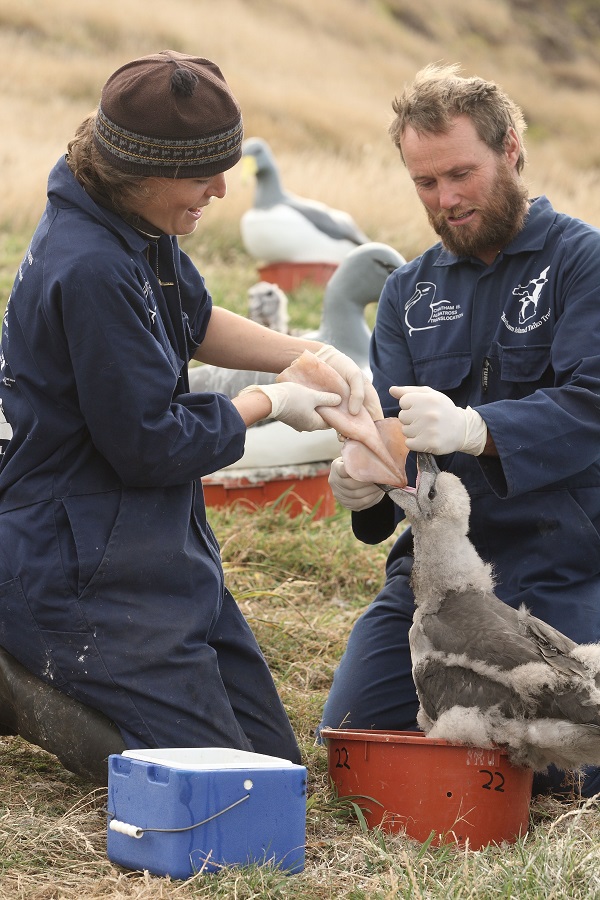 Attempting to establish a new colony: a translocated Chatham Albatross Thalassarche eremita chick gets hand fed a defrosted squid on its artificial nest at Point Gap in the Chatham Islands. Two adult decoys on bucket nests are visible behind (click here)
To increase awareness of this conservation crisis ACAP inaugurated a World Albatross Day (WAD), to be held annually from 2020 on 19 June, the date the Agreement was signed in 2001. This year, the 7th World Albatross Day (WAD2026) will be celebrated by conservationists and wildlife advocates worldwide with the theme “Habitat Restoration”, as an opportunity to highlight the conservation crisis faced by these iconic ocean dwellers. Each year ACAP has chosen a theme to mark the day. The inaugural theme was “Eradicating Island Pests”. “Ensuring Albatross-friendly Fisheries” followed in 2021, then came “Climate Change” in 2022, “Plastic Pollution” in 2023, “Marine Protected Areas” in 2024 and “Effects of Disease” in 2025.
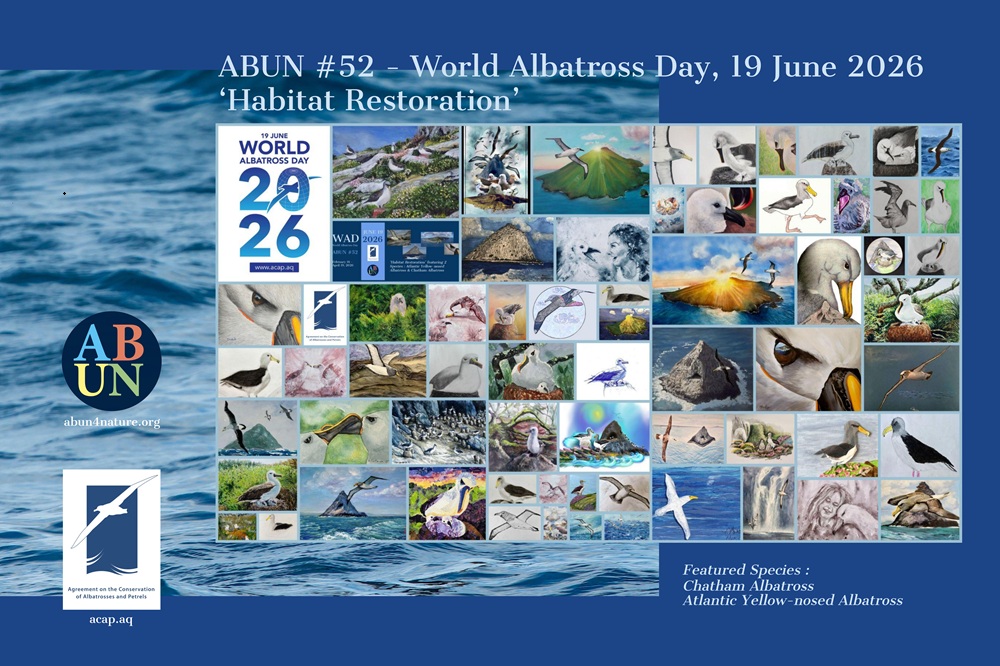 64 artworks by Artists and Biologists Unite for Nature are all depicted in a collage poster by Kitty Harvill
The 2026 theme of Habitat Restoration includes such activities as eradication or control of introduced plants and animals at breeding sites, reducing light pollution, provision of predator-proof fences, establishment of new breeding colonies by attraction techniques and translocations of eggs and chicks, candling and substituting infertile with fertile eggs, supplementary feeding and hydration of chicks, artificial incubation during hatching, and use of artificial nests, fly repellents and sprinkler systems to improve breeding success.
Two albatross species are being used to feature the theme for WAD2026, with posters and infographics being produced in the ACAP official languages, English, French and Spanish, as well as 64 artworks by 37 artists and a music video produced by members of the Artists and Biologists Unite for Nature international collective (ABUN). The featured species are the Endangered Atlantic Yellow-nosed Albatross Thalassarche chlororhynchos, endemic to the Tristan da Cunha islands, part of the United Kingdom Overseas Territory of St Helena, Ascension and Tristan da Cunha in the South Atlantic; and the Vulnerable Chatham Albatross T. eremita, endemic to the Chatham Islands, New Zealand.
A new World Albatross Day logo (in four languages and two formats) has also been produced for 2026.
ACAP Secretariat, 19 June 2026