
 English
  Français
  Español
 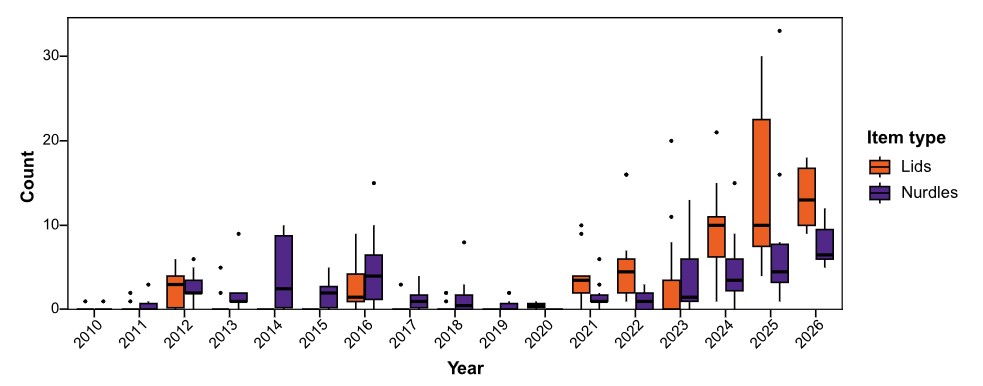 Total number of bottle caps/lids and plastic resin pellets (nurdles) ingested by the “top 10” most impacted Sable [Flesh-footed] Shearwater fledglings from each year on Lord Howe Island, from the publication
Jennifer Lavers (Gulbali Institute, Charles Sturt University, Wagga Wagga, New South Wales, Australia) and colleagues have published open access in the journal Earth's Future on an increase in plastic ingestion by Near Threatened Flesh-footed Shearwaters Ardenna carneipes.
The paper’s abstract follows:
“The world is a complex system with rapid changes making it difficult to anticipate further change and mitigate the impacts. Long‐term ecological studies have contributed disproportionately to our understanding of complex ecosystem responses, including shifts in baseline conditions. While numerous studies have identified serious health consequences resulting from plastics exposure, plastics research often suffers from contradictory messaging. To help address this issue, we use a long‐term plastic ingestion data set for Australian shearwaters (2010–2026) to describe patterns in total plastics exposure over time (number and mass of plastic consumed) as well as two commonly ingested items (plastic bottle caps, plastic resin pellets or “nurdles”). Plastic prevalence within the population (typically 75%–85%) has remained consistent over 16 years; however, there has been a substantial and rapid increase in the mass and number of ingested plastics, including lids and pellets, since 2022. We demonstrate that, had this project been shorter in duration (e.g., the focus of a graduate research project), the conclusions could have been very different, and potentially incomplete. Overall, as the study window increases, a more complete picture becomes apparent: a combination of “good” and “bad” years for the birds, variable patterns in “problematic” items such as lids, and an accelerating trend in the quantity of plastics ingested by fledglings, particularly in the last 5 years. As plastic‐related pressures increase, understanding rapidly changing systems requires thoughtful consideration of the most relevant analyses and metrics which may differ from those used historically.”
Reference:
Lavers, J.L., de Jersey, A.M., Rivers‐Auty, J. & Bond, A.L. 2026. Abrupt recent increases in plastic ingestion by Sable Shearwaters (Ardenna carneipes). Earth's Future 14, e2026EF008572.
John Cooper, Emeritus Information Officer, Agreement on the Conservation of Albatrosses and Petrels, 16 September 2026