
 English
  Français
  Español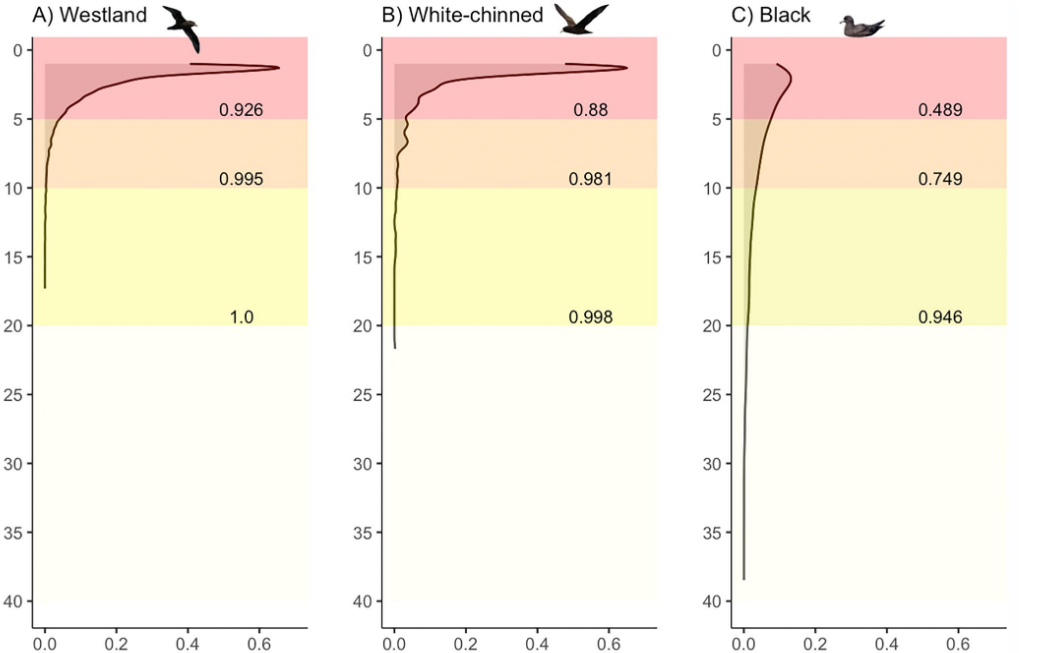
Density plot of maximum dive depths for (A) Westland Petrels, (B) White-chinned Petrels, and (C) Black Petrels. Values on right-hand side of each graph indicate the following: In red sections, the proportion of dives between 0 and 5 m is shown, in orange, the proportion of dives between 0 and 10 m, and yellow, the proportion of dives between 0 and 20 m. From the publication
Maria Rosa Düssler (School of Biological Sciences, Victoria University of Wellington, New Zealand) and colleagues have published in the journal Animal Conservation on diving depth and speed in three species of Procellaria petrels.
Many seabirds are at risk of bycatch including in pelagic and demersal longline fisheries. Bycatch mitigation methods must be informed by seabird foraging behaviour to be effective. Deep-diving seabirds are especially vulnerable to bycatch and also increase risks for less adept divers by bringing baited hooks back to the surface. We deployed time-depth recorders paired with geolocation sensors or GPS loggers in Aotearoa New Zealand to quantify the diving ecology of three Procellaria petrel species (combined total number of dives = 12,767), all of which are vulnerable to bycatch in longline fisheries. We present the deepest dives recorded for each species, with Westland Petrels (Procellaria westlandica; n = 32) reaching 17.3 m, White-chinned Petrels (P. aequinoctialis; n = 14) reaching 21.7 m, and Black Petrels (P. parkinsoni; n = 10) reaching 38.5 m, the deepest dive recorded by a Procellaria petrel. All species dived faster than the best practice longline sink rate of 0.5 m/s. All dived throughout both day and night, but Black Petrels dived more frequently during the day, while Westland Petrels dived more frequently at night. These results suggest that simultaneous implementation of weighted branch lines, bird-scaring lines, and night setting is necessary to reduce bycatch in pelagic longline fisheries. This integrated approach effectively protects hooks from deep-diving Procellaria petrels and prevents them from retrieving hooks and increasing risk to other seabirds. These results also bear direct relevance for custom, target-specific mitigation methods in demersal longline fisheries. Overall, we provide the most in-depth investigation into Procellaria petrel diving ecology to date with wide-ranging implications for seabird conservation globally.”
Reference:
Düssler, M.R., Fischer, J.H., Rowley, O., Bell, E., Charteris, M., Elliott, G., Parker, G.C., Rexer-Huber, K., Simister, K., Taylor, G., Walker, K., Debski, I. & Wittmer, H.U. 2026. Diving ecology of Procellaria petrels highlights the necessity of combining bird-scaring lines, weighted branch lines, and night setting in pelagic longline fisheries. Animal Conservation doi.org/10.1111/acv.70057.
With thanks to Igor Debski, Department of Conservation, New Zealand
John Cooper, Emeritus Information Officer, Agreement on the Conservation of Albatrosses and Petrels, 21 January 2026