
 English
  Français
  Español
 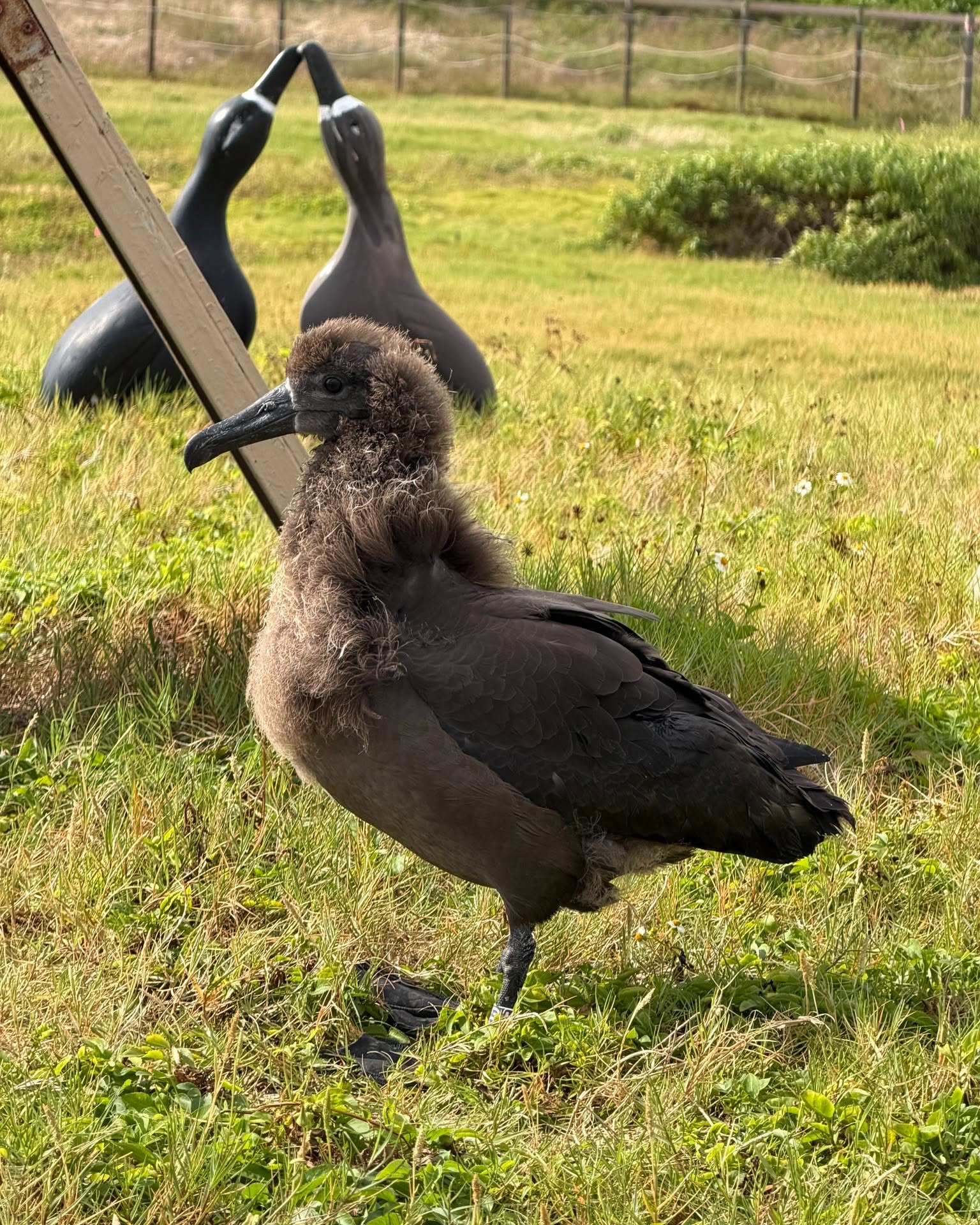 Black-footed Albatross E555 is being reared by translocated parents in the James Campbell National Wildlife Refuge. Two decoys are behind and the chick stands in front of a wooden shelter, photograph from Pacific Rim Conservation
The theme for this year’s World Albatross Day on 19 June is Habitat Restoration, which covers a suite of activities including creating new breeding colonies by translocation efforts and improving the breeding success of ACAP-listed albatrosses and petrels.
The environmental NGO, Pacific Rim Conservation, has been using multiple techniques to create a new breeding locality, safe from predicted sea level rise, on the Hawaiian island of Oahu. Chicks of both Black-footed Phoebastria nigripes and Laysan P. immutabilis Albatrosses have been collected from existing colonies and hand-reared within a predator-proof fence in the James Campbell National Wildlife Refuge. Decoys and sound systems have been used to attract both wild-reared adults and returning hand-reared birds as regularly reported in ACAP Latest News. The very latest information comes in time to mark World Albatross Day this Friday, as reported on Pacific Rim Conservation’s Facebook Page.
“Meet E555, the offspring of our superstar translocated ka‘upu (Black-footed Albatross) pair, V666 and V434. From 2017-2021, we translocated more than 100 ka‘upu chicks from Tern Island and Midway Atoll National Wildlife Refuge to James Campbell National Wildlife Refuge. By late 2025, 35 translocated ka‘upu had returned to JCNWR as adults, and we expect that number to keep rising!
In [2023/24], V666 and V434 made history by successfully raising and fledging their first chick, E999 - the first wild ka‘upu to fledge from Oʻahu in more than 400 years! [click here].
Now, their second chick, E555, is growing up fast and looking strong within the safety of a predator-exclusion fence.”
It seems a new colony for Black-footed Albatrosses is well on its way, so congratulations to Pacific Rim Conservation.
John Cooper, Emeritus Information Officer, Agreement on the Conservation of Albatrosses and Petrels, 14 June 2026