
 English
  Français
  Español
 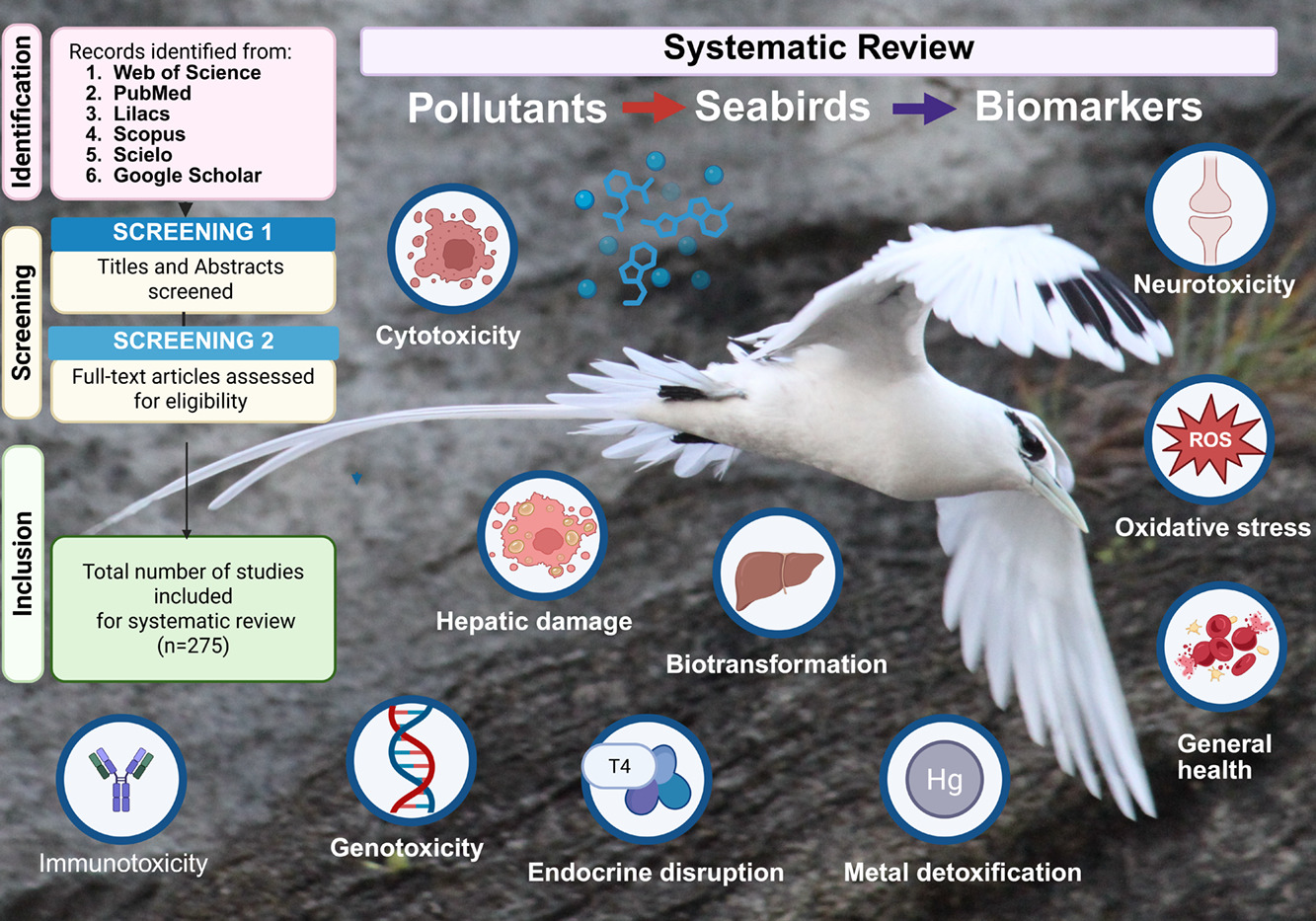 Graphical abstract from the publication
Patricia Serafini (Laboratory of Biomarkers of Aquatic Contamination and Immunochemistry, Federal University of Santa Catarina, Florianópolis, Brazil) and colleagues have reviewed contamination biomarkers in seabirds in the Marine Pollution Bulletin. The paper notes that seabirds are key sentinels for monitoring global marine pollution. A key gap identified was the limited application of biomarkers in Southern Hemisphere seabird species.
The paper’s abstract follows:
“Seabirds are long-lived apex predators that serve as key sentinels of ocean health, integrating contaminant exposure across trophic levels. This systematic review synthesises 275 peer-reviewed studies on biomarkers of aquatic contamination in seabirds, with 124 (45.1%) published in the last decade and the earliest dating back to 1976. Most studies focused on biomarkers associated with organic contaminants (64.0%), metal(loid)s (19.6%), or both (8.0%). Blood was the predominant biological matrix (55.6%), reflecting its suitability for non-lethal monitoring, followed by liver tissue (40.7%), primarily used to assess detoxification pathways. Unlike previous reviews that focused exclusively on molecular biomarkers or synthesised the use of biomarkers across broad aquatic taxa, this study provides the first global, cross-disciplinary synthesis integrating biochemical, cellular, molecular and physiological biomarkers specifically in seabirds. Across the dataset, biomarkers of xenobiotic biotransformation were the most frequently investigated (32.0% of studies), followed by endocrine disruption (20.3%) and oxidative stress (14.9%). A key gap identified was the limited application of biomarkers in the Southern Hemisphere species. Results highlighted the need to incorporate omics approaches, such as transcriptomics and proteomics to improve understanding of sublethal toxicity of aquatic contaminants. Coupling these approaches with non-lethal sampling in ecologically diverse sentinel species and mapping of global contamination hotspots offers a path toward developing sensitive, reproducible indicators of marine environmental health. Collectively, these findings provide an evidence-based framework to guide monitoring programmes and targeted capacity building in underrepresented regions, strengthening transboundary assessment of contaminants impacts and regulatory actions in marine ecosystems.:
With thanks to Patricia Serafini.
Reference:
Serafini, P., Dias, V.H.V., D., da Costa, D.M., da Silveira, G. de E., Geraldo, M.E., Deconto, V.S., Bugoni, L., Bainy, A.C.D., Lüchmann, K.H. 2026. A systematic review of aquatic contamination biomarkers in seabirds and their potential for ocean health monitoring. Marine Pollution Bulletin doi.org/10.1016/j.marpolbul.2026.119234.
John Cooper, Emeritus Information Officer, Agreement on the Conservation of Albatrosses and Petrels, 20 January 2026