
 Español
  English
  Français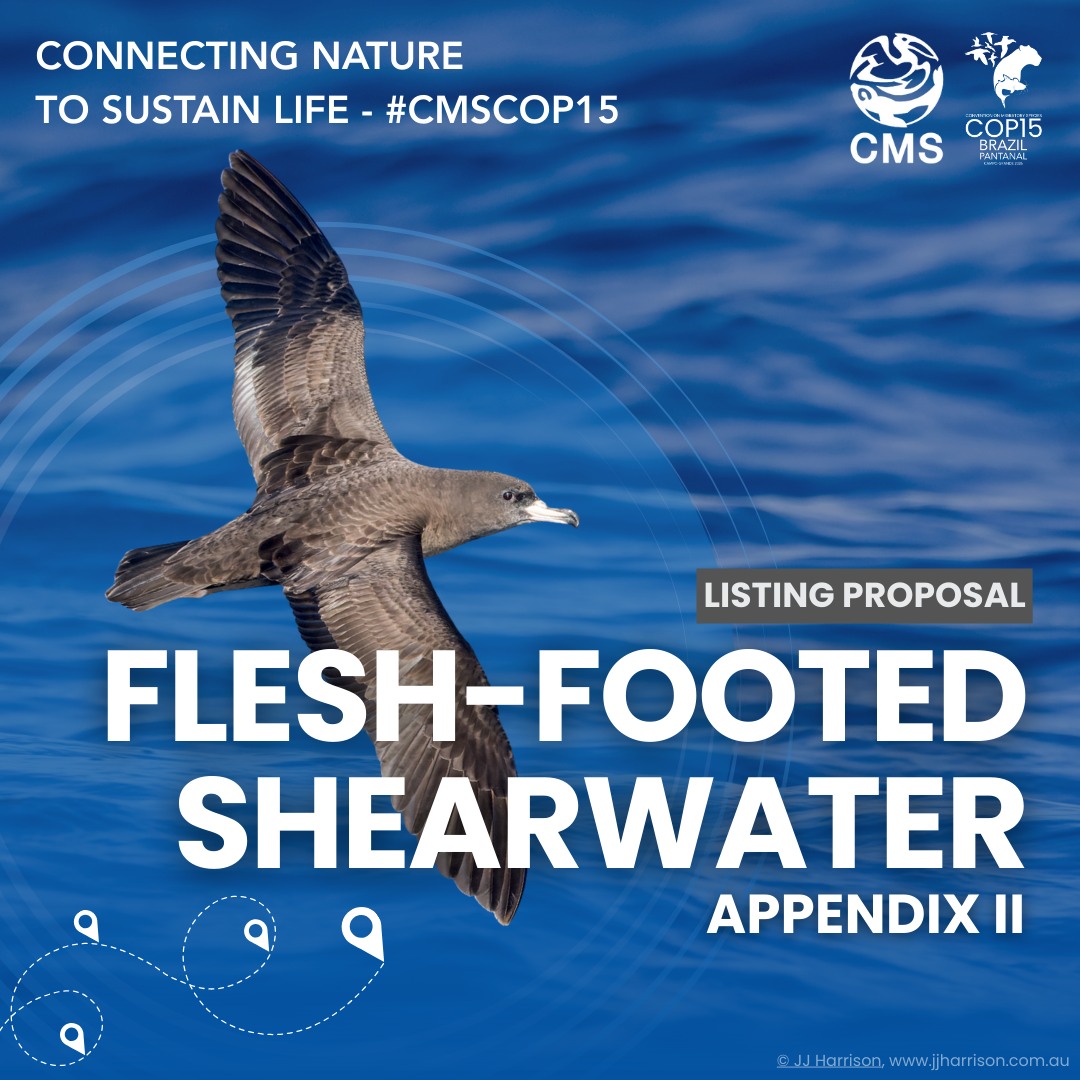
Australia, France and New Zealand have proposed including the Near threatened Flesh-footed Shearwater on Appendix II of the Convention on Conservation of Migratory Species of Wild Animals (CMS, also known as the Bonn Convention). The proposal will be considered at the Fifteenth Meeting of the Conference of Parties (COP15) which will be held over 23-29 March 2026 in Campo Grande, Brazil, with the theme “Connecting Nature to Sustain Life”.
“Flesh-footed Shearwaters breed on islands around northern New Zealand, Australia and the French Southern Territories, then migrate north after breeding to the north-west Pacific and, in some cases, as far as the northern Indian Ocean. Bycatch (especially longline fisheries) is the major threat along the species’ migratory route. Invasive predators, plastic ingestion, climate change, vessel collisions linked to light attraction, and offshore wind farms are also pressures this species faces.” (CMS Facebook).
Appendix II covers migratory species that have an unfavourable conservation status and that require international agreements for their conservation and management, as well as those that have a conservation status which would significantly benefit from the international cooperation that could be achieved by an international agreement.
According to the proposal by the three countries (UNEP/CMS/COP15/Doc.30.2.6) “listing on Appendix II will elevate the suitability score of flesh-footed shearwater for inclusion on Annex 1 of ACAP. A listing on Annex 1 of ACAP would further facilitate the anticipated benefits identified here as ACAP is very active in the development and promotion of best-practice seabird bycatch mitigation advice for relevant fisheries.”
In a supporting document (UNEP/CMS/COP15/Doc.31.3.10) Australia and New Zealand make a proposal for a Concerted Action for the Flesh-footed Shearwater. The document states that “It also complements the work of the Agreement on the Conservation of Albatrosses and Petrels (ACAP), a CMS subsidiary agreement” and that the Flesh-footed Shearwater is a “highly suitable candidate for listing on Annex 1 of ACAP.”
It continues “There are no other international cooperation initiatives with a focus on flesh-footed shearwater. The notable related mechanism in place with relevance to flesh-footed shearwater is ACAP, where ACAP Parties cooperate on matters such as development of seabird bycatch mitigation advice, and through conservation and management measures adopted by RFMOs. However, as flesh-footed shearwaters are not listed on Annex 1 of ACAP, ACAP’s actions do not provide a high level of advocacy for flesh-footed shearwater and may fail to focus efforts on fisheries that may impact flesh-footed shearwater but not ACAP-listed species. An additional benefit of listing flesh-footed shearwater on Appendix II of CMS is that this will elevate the suitability score of flesh-footed shearwater for inclusion on Annex 1 of ACAP. Such a listing would further facilitate the anticipated benefits identified here. Given CMS has more Parties with jurisdiction across the range of flesh-footed shearwater than ACAP, listing on both CMS and ACAP would maximise international cooperation to conserve flesh-footed shearwater.”
The ACAP Monthly Missive for December 2025 previously reported on the CMS proposal and considered whether the Flesh-footed Shearwater should be ACAP listed, following discussion at the 2019 Meeting of the Advisory Committee (AC11) in Brazil (click here).
ACAP Latest News will report on the outcome of the proposed listing by the Convention on Migratory Species once it becomes known. ACAP will hold the Fifteenth Meeting of its Advisory Committee (AC15) from 1-5 June 2026 in Swakopmund, Namibia, when it will have an opportunity to consider the outcome of the proposal to list the Flesh-footed Shearwater on CMS Appendix II by three of its Parties.
It is to be noted that any opinions expressed in ACAP Monthly Missives are not to be taken as those of the ACAP Secretariat or any of the Agreement’s Parties.
John Cooper, Emeritus Information Officer, Agreement on the Conservation of Albatrosses and Petrels, 20 March 2026