
 English
  Français
  Español
 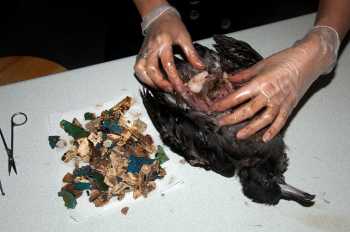 Removing plastic fragments from a Flesh-footed Shearwater stomach, photograph by Ian Hutton
Alex Bond (Bird Group, Natural History Museum, Tring, United Kingdom) and colleagues have published open access in the journal Marine Pollution Bulletin on a study of plastic pollution in the Near Threatened Flesh-footed or Sable Shearwater Ardenna carneipes, a potential candidate species for ACAP listing. They found no sex differences in frequency, mass, number, colour or type of ingested plastic.
The paper’s abstract follows:
“Sex-based differences in plastic ingestion by wildlife are understudied. Studies from the 1980s of birds shot at sea found no sex differences in plastic ingestion by post-fledging and adult birds, but nest-bound age classes remain unstudied. We quantified plastic ingestion by 114 Sable Shearwaters (Ardenna carneipes) fledglings from Lord Howe Island, Australia, in 2023, and compared the frequency of ingestion, number of pieces, mass, and colour and type composition between sexes. We found no difference in the frequency of plastic ingestion, the mass, number of pieces, colour, or type composition of ingested plastics between female and male fledglings. There was no evidence of a sex ratio bias in the sampled population. The genetic sex of chicks is not a predictor of ingested plastics, but the potential for a biased sex ratio among chicks and adults could compound ongoing population declines.”
Reference:
Bond, A.L., Reynolds, J., de Jersey, A.M., Grant, M.L., Rivers-Auty, J., Griffin, C. & Lavers, J.L. 2026. No evidence of sex differences in plastic ingestion by Sable Shearwater (Ardenna carneipes) chicks. Marine Pollution Bulletin 225. doi.org/10.1016/j.marpolbul.2026.119324.
John Cooper, Emeritus Information Officer, Agreement on the Conservation of Albatrosses and Petrels, 28 January 2026