
 English
  Français
  Español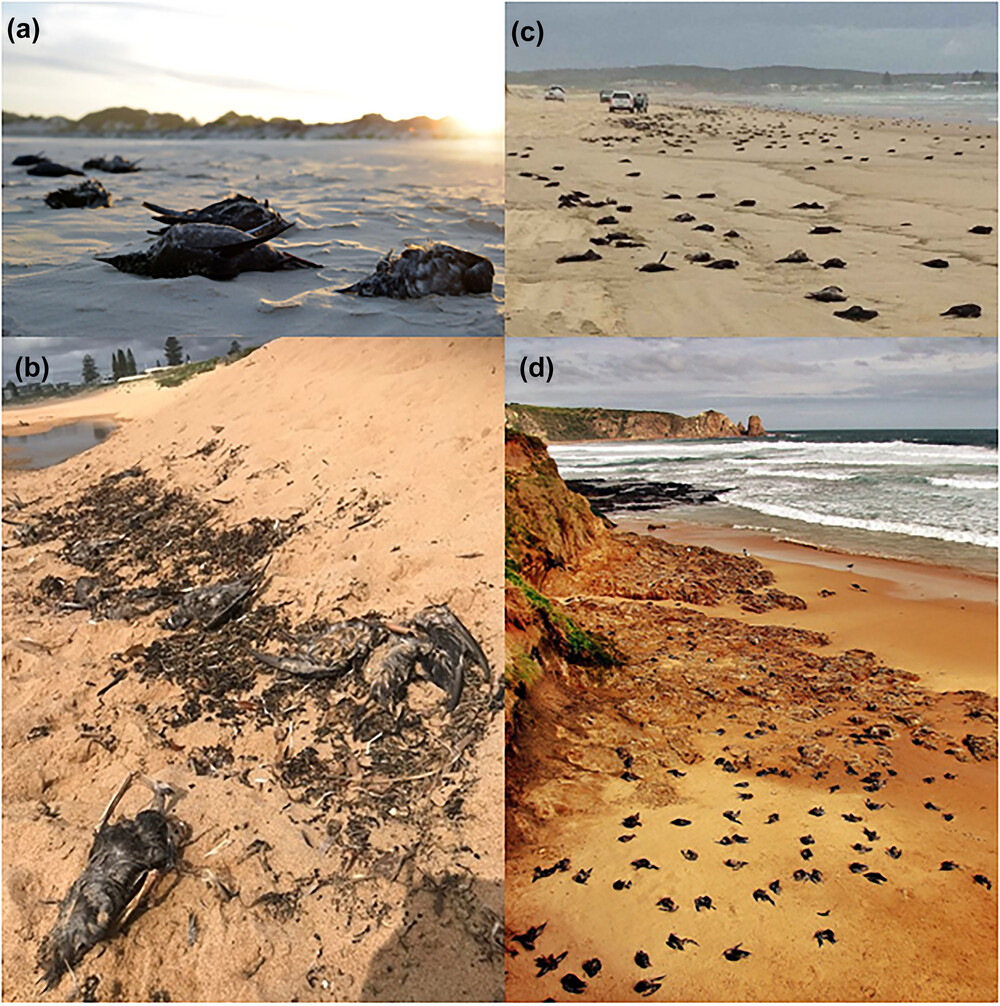
Images of deceased shearwaters on beaches in southeastern Australia, from the publication
Jennifer Lavers (Adrift Lab, Underwood, Tasmania, Australia) and colleagues have published open access in the journal Conservation Biology, reporting that marine heat waves resulted in an estimated 629 000 seabird deaths, notably of two Australian shearwater species, in 2023–2024.
The paper’s abstract follows:
“Marine heat waves detrimentally affect a range of marine species, including seabirds, and are increasing in frequency and severity. When thousands of dead seabirds wash up on beaches, the public becomes concerned. However, the number of dead birds recorded on beaches is only a fraction of the total mortality; most birds perish at sea. As a result, estimates of total mortality are scarce, and this impedes the ability to determine how such mortality events affect populations. Community science programs can greatly enhance the geographic or temporal scale of studies, which can be critical when mortalities or changes take place over large distances or many months. Using three community science data repositories, we examined the number and composition of seabirds found dead on beaches in eastern Australia during the 2023–2024 marine heat wave. Mortality estimation models developed for other sectors were refined using measures of searcher efficiency and carcass persistence for beach-washed birds. Total mortality of sable shearwaters (Ardenna carneipes) and short-tailed shearwaters (Ardenna tenuirostris) was >13,900 and >608,000, respectively. The loss of these birds, in total more than 629,000 individuals, highlights the increasingly perilous marine environment in which many marine species now exist.”
Reference:
Lavers, J.J., Fulton, W., Stuckenbrock, S. & Bond, A L. 2026. Estimating the total mortality of seabirds following a marine heat wave. Conservation Biology doi.org/10.1111/cobi.70273.
John Cooper, Emeritus Information Officer, Agreement on the Conservation of Albatrosses and Petrels, 28 April 2026