
 English
  Français
  Español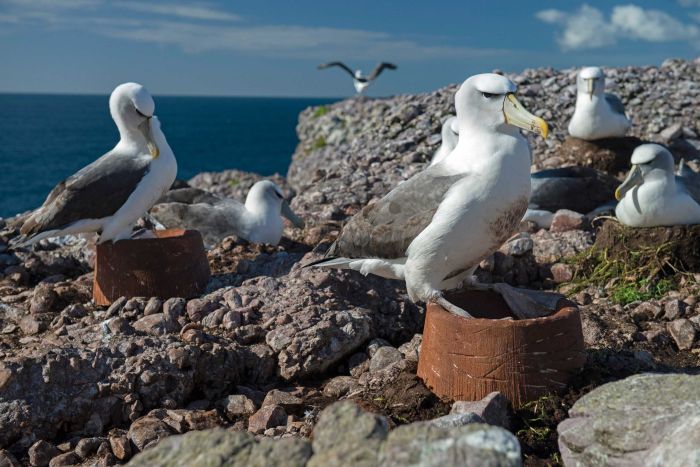
Two Shy Albatrosses sit on their artificial nests on Albatross Island; the birds behind are natural mud nests they have made, photograph by Matthew Newton, WWF Australia
Here follows a report of efforts to improve the breeding success of Near Threatened Shy Albatrosses Thalassarche cauta that falls directly within the theme of “Habitat Restoration” for World Albatross Day on 19 June 2026.
“The Shy albatross (Thalassarche cauta) is listed as Vulnerable under the Threatened Species Protection Act 1995. It is unique to Tasmania, breeding exclusively on three offshore islands: Albatross Island in western Bass Strait and Pedra Branca and the Mewstone south of Tasmania. The total population is estimated to be around 15 000 annual breeding pairs.
Shy albatross populations have been studied since the 1980s by the Department of Natural Resources and Environment Tasmania (Marine Conservation Program) and in partnership with the CSIRO has been working to understanding how shy albatross will be impacted by climate change in the short and long-term. We aim to use this knowledge to identify practical on-ground adaptation options that will help buffer the species against negative effects.
Potential adaptation options include building wind breaks, tr uanslocations, building artificial nests, reducing disease and reducing bycatch from fisheries. Each option will vary in its magnitude of benefit and act upon different components of the population demographics (through one or more of chick, juvenile or adult survival, and breeding success).
Albatross make nests using mud surrounding the nest area, in which they lay one egg. Higher nests have higher chick survival than low nests. One of the options we tested to help shy albatross was to supply them with artificial nests made of air-blown concrete. These nests keep the egg and chick out of the mud. In our trial of using more than 100 artificial nests, chick survival was almost three times higher compared to natural nests.
Testing these adaptation options is helping both birds and conservation managers to prepare and cope with a warmer world and provides options to keep larger populations of these magnificent birds.”
Read more about the artificial albatross nests on Albatross Island here and here.
John Cooper, Emeritus Information Officer, Agreement on the Conservation of Albatrosses and Petrels, 09 June 2026