
 English
  Français
  Español
 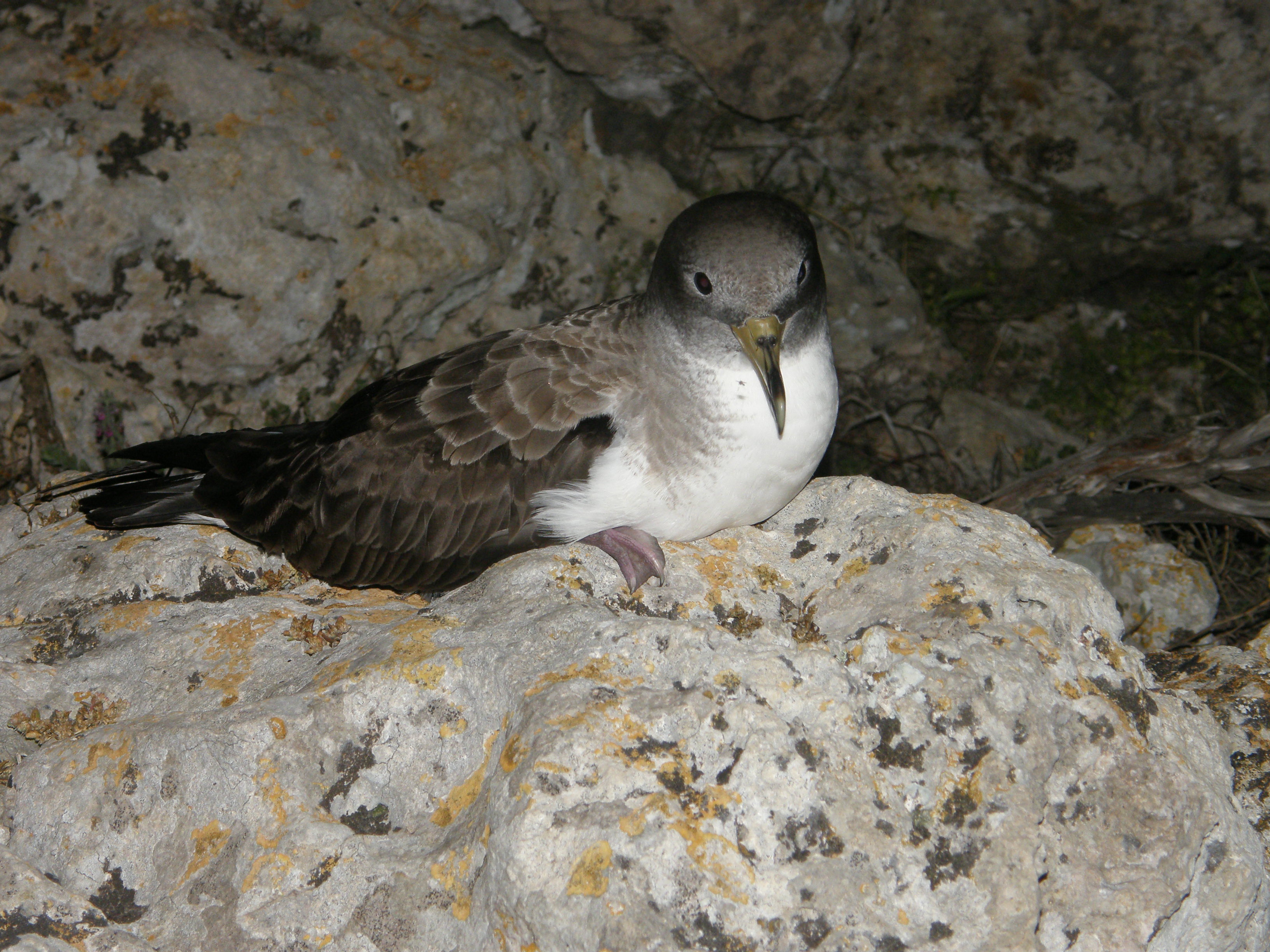 A Scopoli’s Shearwater in the study colony, Strofades Islands, Ionian Sea, photograph by Georgios Karris
Catherine Tsangaris (Institute of Oceanography, Hellenic Centre for Marine Research, Anavyssos, Greece) and colleagues have published in the Marine Pollution Bulletin on biomarkers in Scopoli's Shearwater Calonectris Diomedea.
The paper’s graphic and text abstracts follow:
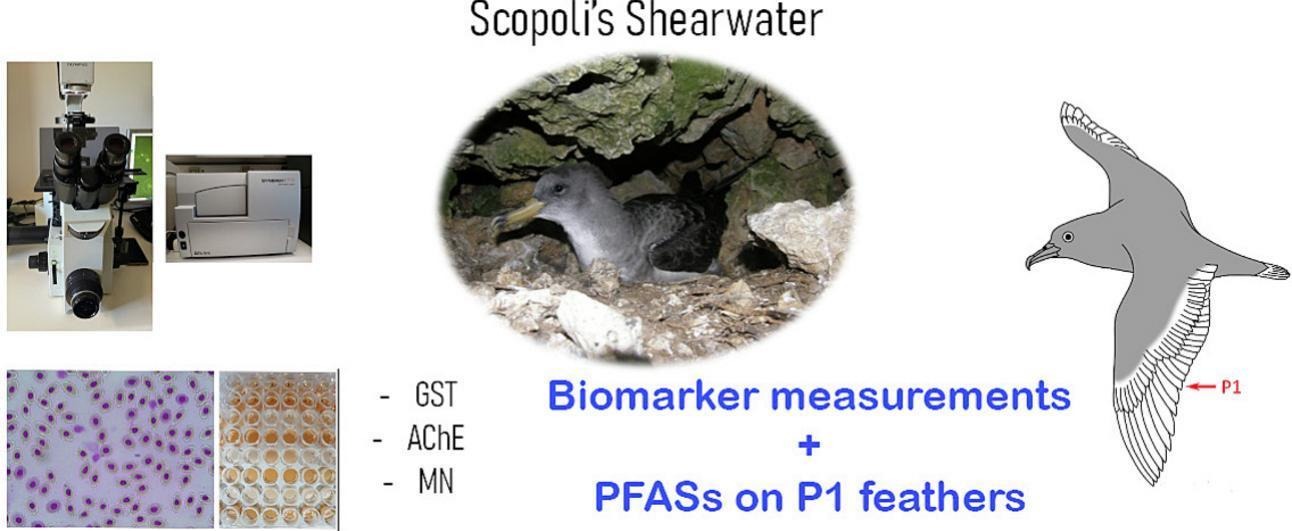
“Ecotoxicological biomarkers are valuable tools for assessing pollution effects in marine organisms. This study investigates a set of biomarkers in Scopoli's shearwater (Calonectris diomedea) from a colony in the Eastern Mediterranean (Strofades Islands, Ionian Sea) and examines their association with seabird size (body mass and morphometrics), sex, life stage (breeder vs prospector), and per- and polyfluoroalkyl substances (PFAS) concentrations in feathers. The biomarker set included the micronucleus (MN) test as a biomarker of genotoxicity, glutathione-S-transferases (GST) as a biomarker of xenobiotic biotransformation, and acetylcholinesterase (AChE) as a biomarker of neurotoxicity. Our results indicate that biomarker values were not influenced by life stage, sex, or size within the sampled seabird range, supporting their suitability for contaminant assessment. Additionally, GST activity was associated with perfluoroalkane sulfonyl fluorides (PASFs) exposure, suggesting potential induction for PASFs biotransformation. Neither MN frequency nor AChE activity was influenced by PFASs concentrations in the feathers. To our knowledge, this is the first study on biomarkers of genotoxicity, biotransformation and neurotoxicity in Scopoli's shearwater. Our findings provide baseline MN frequencies, GST, and AChE activities in this species at the largest species colony in the Eastern Mediterranean and highlight the need for further research across different colonies to assess geographic variations in contaminant exposure and biomarker responses.”
With thanks to George Karris Γεώργιος Καρρής.
Reference:
Tsangaris, C., Patsiou, D., Trypidaki, E., Xirouchakis, S., Zhang, J., Asimakopoulos, A.G. & Karris, G. 2026. Ecotoxicological biomarkers in Scopoli's shearwaters (Calonectris diomedea) from an Eastern Mediterranean colony and associations with per- and polyfluoroalkyl substances (PFASs) in their feathers. Marine Pollution Bulletin 226. doi.org/10.1016/j.marpolbul.2026.119328.
John Cooper, Emeritus Information Officer, Agreement on the Conservation of Albatrosses and Petrels, 06 February 2026